September 30, 2026
10 min
Nathan J
July 20, 2026
9 min
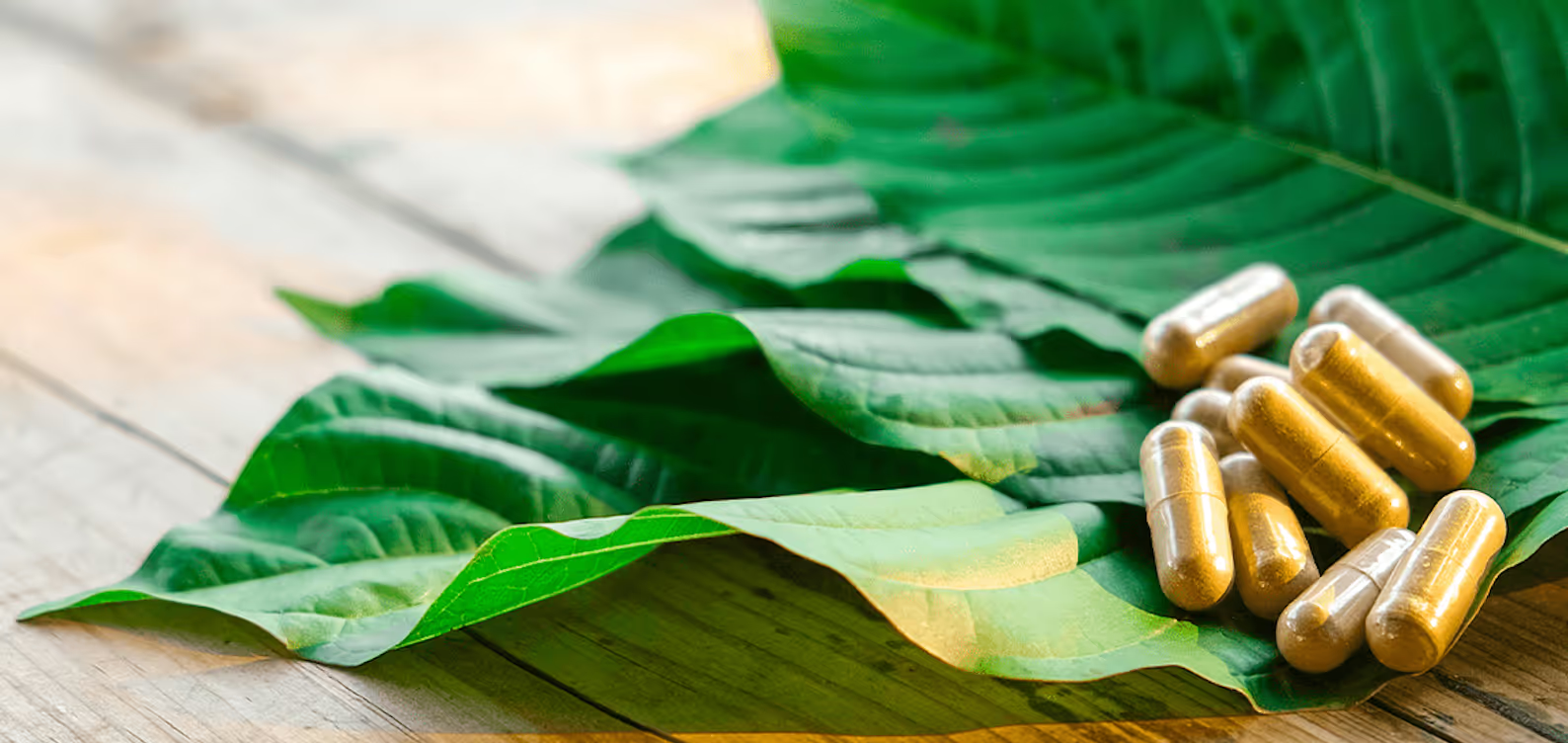
Millions of Americans buy kratom at gas stations, smoke shops, and online retailers — yet the FDA still has not approved it for any medical use. In 2026, the agency published its very first clinical trial on botanical kratom leaf, finding no serious adverse events at doses up to 12 grams. Meanwhile, a potent derivative called 7-hydroxymitragynine is being targeted for Schedule I classification. The science is finally catching up to the controversy — and the results are more nuanced than either side wants to admit.
Bottom Line Up Front
✅ Two controlled clinical trials (2026) found that plain kratom leaf powder produced no serious adverse events in healthy adults at standard doses, and the FDA’s own pilot study confirmed dose-dependent opioid-like effects with a manageable safety profile.
⚠️ Long-term safety data remain absent, dependence and withdrawal are documented in regular users, and concentrated 7-OH products carry significantly higher risks that should not be conflated with natural leaf.
⚕️ LyfeiQ Score: 4/10 — Pharmacologically active with genuine potential, but insufficient clinical evidence, an unregulated market, and real dependence risk keep kratom firmly in “proceed with caution” territory.
Kratom’s pharmacology is more complex than most supplements and more subtle than most opioids. The plant Mitragyna speciosa contains over 40 alkaloid compounds, but two dominate its effects: mitragynine (roughly 60–65% of dried leaf alkaloid content) and 7-hydroxymitragynine (7-OH), a minor constituent comprising less than 2% of total alkaloids. Both interact with mu-opioid receptors in the brain, but they work differently than traditional opioids like morphine or oxycodone. Mitragynine acts as a partial agonist rather than a full agonist — producing milder effects with a ceiling, meaning that beyond a certain dose, increasing the amount does not proportionally increase the effect. This distinction is pharmacologically significant because full agonists like heroin create intense euphoria and dangerous respiratory depression, while partial agonists generally do not.
The biggest development in kratom research came in early 2026, when two landmark clinical trials were published. The FDA’s own pilot study, led by pharmacologist Chad Reissig and published in the Journal of Clinical Psychopharmacology in March 2026, enrolled 40 healthy adults with prior opioid experience in a double-blind, placebo-controlled design. Participants received single ascending doses of botanical kratom (1, 3, 8, 10, and 12 grams). No deaths or serious adverse events occurred. The most common side effects were nausea, somnolence, and vomiting — primarily at higher doses. The 12-gram dose produced pupillary constriction and increased subjective ratings of “drug liking,” consistent with opioid-like activity. A separate, larger trial published in January 2026 in Therapeutic Drug Monitoring tested a well-characterized kratom leaf powder in 116 healthy adults across both single-dose and 15-day repeated-dose arms. Again, no serious adverse events were reported. Some participants in the highest dose group showed mild elevations in liver enzymes (ALT and AST), but no cases met criteria for clinically significant liver injury.
Earlier survey-based research provides context for how people actually use kratom. A 2024 ecological momentary assessment study by Dr. Kirsten Smith at Johns Hopkins, published in JAMA Network Open, tracked hundreds of kratom users in real time. Most reported using kratom for pain management, mood improvement, or opioid withdrawal support. A landmark 2020 Johns Hopkins survey of 2,798 users found that most took 1–3 grams per dose, with effects lasting 2–5 hours, and documented a low rate of adverse events when kratom was used alone — but significantly higher risks when combined with other substances.
Dependence and withdrawal are the most consistently documented concerns. Dr. Smith’s 2022 study in the Journal of Addiction Medicine assessed kratom use disorder (KUD) using DSM-5 criteria among a diverse sample of current and former users. About 30% met criteria for current KUD, but severity was predominantly mild. The primary features were tolerance, withdrawal, and unsuccessful quit attempts — not the severe psychosocial impairments typically associated with opioid addiction. Withdrawal symptoms included gastrointestinal upset, restlessness, anxiety, irritability, fatigue, and craving — generally milder than opioid withdrawal. Smith is now leading the first empirical study to directly measure kratom withdrawal under controlled laboratory conditions at Johns Hopkins.
The FDA has historically linked kratom to at least 44 deaths between 2011 and 2017. However, the vast majority of those cases involved polydrug use — kratom combined with opioids, benzodiazepines, or other substances. Cases involving kratom alone remain contested due to limited toxicological analysis. State-level overdose data from 2020–2022 documented kratom involvement in over 2,000 overdose cases, though distinguishing natural leaf from concentrated 7-OH products in toxicology reports remains difficult.
Liver injury represents another documented but uncommon risk. Case reports in the Annals of Internal Medicine have described hepatotoxicity in kratom users, with some cases requiring transplantation. However, causation is difficult to establish because patients used various products from unregulated sources, raising questions about contamination or adulteration rather than kratom’s inherent toxicity. The 2026 multi-dose trial noted mild liver enzyme elevations at higher daily doses, reinforcing the need for monitoring but showing no severe liver events.
If you are considering kratom, the practical reality is that you are navigating an unregulated market with real pharmacological effects. Based on available evidence, here are the key considerations:
Dosing matters significantly. Research consistently shows that lower doses (1–3 grams of leaf powder) produce stimulant-like effects, while higher doses (5–12 grams) produce opioid-like sedation and pain relief. The FDA’s pilot study confirmed this dose-dependent pattern. Starting low and staying at the lowest effective dose is the most evidence-supported approach.
Avoid daily use if possible. Tolerance and physical dependence develop with regular use, as documented across multiple studies. If daily use has already become established, abrupt cessation can produce withdrawal symptoms — manageable but uncomfortable.
Never combine kratom with alcohol, benzodiazepines, opioids, or other central nervous system depressants. The risk of respiratory depression and death increases substantially with polydrug use. Most kratom-associated fatalities have involved combinations with other substances.
Source from vendors who provide third-party lab testing. Product quality varies dramatically in the unregulated market. The FDA’s clinical trials used a single, well-characterized product — conditions that do not reflect the typical consumer experience. Look for certificates of analysis that test for alkaloid content, heavy metals, pathogens, and adulterants.
Avoid concentrated 7-OH products entirely. The FDA has specifically distinguished these from natural kratom leaf, citing substantially greater opioid potency and risks including addiction, respiratory depression, and seizures. These products — sold as gummies, tablets, shots, and drink mixes — are the primary target of current federal enforcement actions.
Discuss your use with a healthcare provider. Even if you fear judgment, honest disclosure allows your doctor to monitor for drug interactions and liver function.
The medical establishment has shifted from blanket opposition toward cautious engagement with the research. The FDA’s position has evolved notably. While the agency still maintains that kratom is not appropriate for use as a dietary supplement and has no approved therapeutic use, its decision to fund and conduct clinical trials signals a willingness to let data guide policy. The 2025 recommendation to schedule concentrated 7-OH products — while explicitly not targeting natural kratom leaf — represents a more nuanced approach than the agency’s failed 2016 attempt to ban all kratom.
Dr. Christopher McCurdy, a medicinal chemist at the University of Florida who has studied kratom for nearly 20 years and collaborated on the FDA’s pilot study, has argued that dismissing kratom entirely ignores its potential as both a harm reduction tool and a therapeutic starting point. He emphasizes the need for rigorous clinical trials rather than blanket prohibition.
The American Academy of Family Physicians continues to advise against kratom use, citing insufficient safety data and contamination risks. Mayo Clinic toxicologists acknowledge kratom’s complexity, warning patients about quality control issues while noting that informed decision-making with medical supervision is preferable to outright prohibition.
Harm reduction advocates view kratom through the lens of real-world alternatives rather than ideal clinical standards. Dr. Kirsten Smith at Johns Hopkins has been one of the most prominent voices bridging research and advocacy. Her work has shown that most kratom users are self-treating conditions that the healthcare system has failed to address adequately — chronic pain, opioid withdrawal, anxiety, and depression. Her 2024 JAMA Network Open study found that kratom use was generally not accompanied by the severe social or functional impairments characteristic of opioid addiction, even among users who met technical criteria for kratom use disorder.
Traditional use provides some historical context. For centuries, Southeast Asian laborers have used kratom leaves to manage pain and increase stamina during physically demanding work. This traditional pattern — chewing fresh leaves at low doses — differs dramatically from the high-dose consumption of concentrated extracts that concerns regulators today.
The National Center for Complementary and Integrative Health (NCCIH) notes that kratom’s safety and effectiveness have not been established for any therapeutic use, but acknowledges ongoing research. The American Association of Naturopathic Physicians takes a cautious position, emphasizing that kratom may benefit some patients but requires quality control, dosing guidance, and medical supervision — elements currently lacking in the unregulated market.
Kratom occupies a polarized space online where personal testimony often substitutes for clinical evidence. Reddit communities like r/kratom and r/quittingkratom present dramatically different narratives. The former features users describing life-changing pain relief and successful opioid tapering. The latter documents struggles with dependence, escalating doses, and difficult withdrawals. Both experiences appear genuine, reflecting the wide individual variation in response to kratom.
On YouTube, creators who discuss kratom tend to fall into two camps: wellness-oriented channels that frame kratom as a natural tool for self-optimization, and addiction recovery channels that warn about dependence. The Kratom Science Podcast, run by researcher Brian Gallagher, has provided a more evidence-based platform that features perspectives from both camps.
The public conversation around 7-OH products has shifted significantly in 2025–2026. Products marketed as “legal morphine” in gas stations and vape shops — often in forms appealing to young people like gummies and flavored shots — have drawn widespread concern even from kratom advocates who support access to natural leaf. The American Kratom Association has publicly supported the distinction between natural leaf and concentrated 7-OH products, positioning itself in favor of regulation rather than prohibition.
The most important distinction in the kratom conversation is the one the FDA finally made explicit in 2025: natural kratom leaf and concentrated 7-OH products are not the same thing. Natural leaf contains trace amounts of 7-OH (less than 2% of total alkaloids), while commercial 7-OH products can contain synthetically elevated concentrations with potency exceeding morphine. Conflating these products in research, regulation, or public discussion serves no one.
The clinical trial data from 2026 should temper both extremes. Kratom is not the harmless herb that some advocates claim — it produces measurable opioid-like effects, causes physical dependence with regular use, and its long-term safety profile remains unknown. But it is also not the deadly threat that some officials have suggested — two controlled trials found no serious adverse events, and the partial agonist pharmacology appears to produce a genuinely different risk profile than full opioid agonists.
One persistent myth needs addressing: “natural” does not mean “safe.” Tobacco, cocaine, and opium are all plant-derived. Traditional use provides some reassurance about acute toxicity at low doses, but it does not validate high-dose daily consumption of concentrated extracts purchased from unregulated sources.
The research pipeline is more active now than at any point in kratom’s U.S. history. The FDA’s Human Abuse Potential (HAP) study — a randomized, placebo-controlled trial comparing kratom’s subjective effects to oxycodone — began enrolling in late 2024, with results expected by late 2026. This study will be critical in determining whether the DEA pursues scheduling of kratom itself. At Johns Hopkins, Dr. Smith is conducting the first empirical laboratory study of kratom withdrawal, a step toward evidence-based treatment guidelines. And the growing body of alkaloid characterization research at the University of Florida is laying the groundwork for potential pharmaceutical development of isolated kratom compounds with better safety profiles than whole-leaf products.
Credibility Rating: 4/10
👉 Who should try this: Adults with chronic pain or opioid withdrawal who have discussed options with a healthcare provider, can source lab-tested natural leaf products, and commit to low-dose, intermittent use with monitoring.
👉 Who should skip this: Anyone with liver disease, anyone taking CNS depressants or opioids, pregnant or nursing individuals, anyone under 21, and anyone seeking concentrated 7-OH products.
⚕️ LyfeiQ Score: 4/10 — Kratom is pharmacologically active with genuine effects on opioid receptors, and two 2026 clinical trials have improved the evidence base for acute safety of plain leaf. However, the absence of long-term data, documented dependence potential, and a wildly unregulated market mean that informed caution remains the only responsible approach.
For more on evidence-based supplement analysis, read our deep dive on why creatine is more than a gym supplement.
Disclaimer: This content includes personal opinions and interpretations based on available sources and should not replace medical advice. This content includes interpretation of available research and should not replace medical advice. Although the data found in this blog and infographic has been produced and processed from sources believed to be reliable, no warranty expressed or implied can be made regarding the accuracy, completeness, legality or reliability of any such information. This disclaimer applies to any uses of the information whether isolated or aggregate uses thereof.