
September 30, 2026
9 min
Kenneh D
July 20, 2026
8 min

“There’s antifreeze in your soda” is the rare myth that’s almost true — which is exactly why it travels so well. A soft drink really can contain propylene glycol, and propylene glycol really does turn up in some antifreeze. The lethal green liquid in your car, though, is a completely different chemical.
What the evidence supports: The confusions behind most “toxic ingredient” panics are real and easy to document. People mistake one chemical for a similarly named one, or ignore how little of it is actually present. Toxicologists are close to unanimous that a substance’s name — or its use in some factory — tells you almost nothing about whether it’s safe to eat. What’s overstated or unsupported: The leap from “scary-sounding” to “dangerous.” Two things decide actual danger: the dose, and the precise chemical identity — not the syllable count, and not a search that stops at the word “glycol.” ⚕️ LyfeiQ Score: 3/10 — As a guide to what’s actually harmful, “scary name equals poison” is unreliable. Learn two ideas and you’ll outperform most headlines.
Researchers have a name for the reflexive dread of synthetic-sounding ingredients: chemophobia. In a survey of 5,631 people across eight European countries, scientists at ETH Zurich found that the less people understood basic toxicology, the more intense their fear of chemicals became, according to research published in Food and Chemical Toxicology. Two blind spots stood out: the dose-response relationship — the principle that the amount determines the harm — and the assumption that a synthetic molecule must be more dangerous than a “natural” one. A follow-up experiment by the same group found that teaching people a little toxicology reduced chemophobia, while simply trying to make them feel warmer toward chemicals did not. Writing in Nature Chemistry, the same researchers argued these biased risk perceptions are predictable and, with the right communication, correctable.
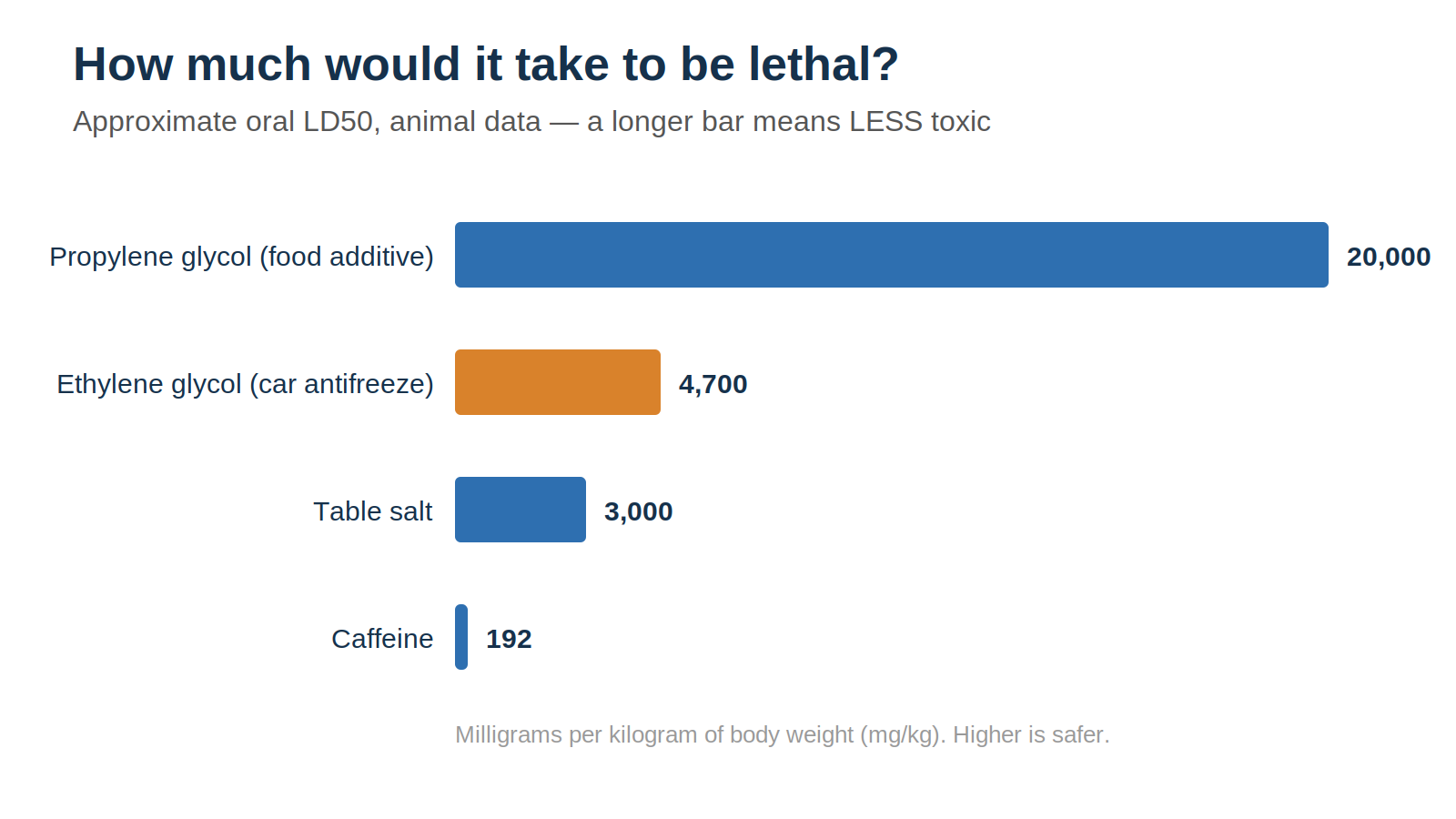
The propylene glycol story is a textbook case. Propylene glycol is classified by the U.S. Food and Drug Administration as “generally recognized as safe,” and it shows up in some sodas as a carrier that keeps flavorings evenly mixed, per the International Food Information Council. It does have an industrial cousin: ethylene glycol, the sweet-tasting, genuinely poisonous liquid in conventional automotive antifreeze. The two get blurred into one frightening headline. The irony writes itself — propylene glycol is now used in “non-toxic” RV and marine antifreeze precisely because it is so much safer than the ethylene kind.
How much safer? Acute-toxicity testing makes the gap almost comic, which is where a picture helps more than a paragraph.
Two questions defuse almost every ingredient scare. First: how much is in there? A compound that’s harmful by the gallon can be harmless by the milligram, which is why the FDA caps additives like propylene glycol at low percentages rather than banning them. Second: what exactly is this molecule? “Glycol,” “acid,” and “-amide” are chemical family names, not verdicts. Ascorbic acid is vitamin C. Tocopherol is vitamin E. Cyanocobalamin — the B12 in your cereal — contains a cyanide group, yet the amount is trivial and your body clears it without trouble.
A practical habit: when a label word alarms you, look up the specific compound rather than the category, and check whether the worry is about realistic intake or a laboratory megadose. Watch, too, for the tell that a scare conveniently sells you something — a pricier “clean” version of the same product. Guilt by association (“it’s also in yoga mats!”) is a marketing move, not a toxicology finding.
The scientific position rests on a 500-year-old idea usually credited to Paracelsus: the dose makes the poison. Regulators like the FDA and the European Food Safety Authority set limits based on how much of a substance a person could plausibly consume, with large safety margins built in. Monosodium glutamate is a useful test of the principle. A 2019 review in Comprehensive Reviews in Food Science and Food Safety examined the alleged hazards of MSG and concluded that reports of “Chinese restaurant syndrome,” heightened pain sensitivity, and other effects had little supporting evidence; the harms seen in lab studies came from doses far beyond anything a person eats. Glutamate, the review noted, is the same molecule that occurs naturally in tomatoes, parmesan, and human breast milk.
Consumer-advocacy groups occupy the uncomfortable, useful middle ground — sometimes right, sometimes overcautious. Organizations like the Center for Science in the Public Interest and the Environmental Working Group have pushed for stricter additive review for decades. Sometimes the science vindicates them. Brominated vegetable oil, a stabilizer once common in citrus sodas, was flagged by advocates for years; in 2024 the FDA revoked its authorization after studies with the National Institutes of Health found the potential for harm. Other times these groups publish sweeping “avoid this” lists that lump well-studied, safe additives in with genuinely questionable ones — which can train people to fear the label instead of reading it. Proponents of the clean-label movement argue that uncertainty justifies caution; critics counter that undifferentiated alarm erodes trust in the cases that actually matter.
On social media, the dominant rule is blunt: if you can’t pronounce it, don’t eat it. The blogger Vani Hari, known as the Food Babe, built a large following on exactly this logic. Her 2014 campaign against azodicarbonamide — a dough conditioner she nicknamed the “yoga mat chemical” because it’s also used to foam plastics — collected tens of thousands of signatures and pushed Subway to reformulate its bread. The framing was rhetorically sharp and scientifically beside the point: the same compound behaves entirely differently as a trace baking agent than as a plastic blowing agent. Not everyone online plays it that way. A growing group of chemists, registered dietitians, and science communicators now spend their feeds doing the opposite — explaining dose, debunking guilt-by-association, and pointing out that “natural” cassava and almonds contain cyanide compounds too. The reductio that science teachers love: a petition to ban “dihydrogen monoxide” — water — for being found in industrial solvents and acid rain.
The part the loudest voices on both sides tend to miss is simple: scary framing and real risk are independent variables. A frightening nickname doesn’t make a molecule dangerous, and a reassuring “GRAS since 1960” doesn’t guarantee it’s safe forever. Azodicarbonamide shows the first half. The “yoga mat” line is guilt by association, but there’s a separate, legitimate reason the EU, UK, and Australia restrict it: during baking it can form small amounts of semicarbazide, a compound flagged as a possible carcinogen, and those regulators chose precaution. Brominated vegetable oil shows the second half. Calling it a “flame retardant” was its own sleight of hand — BVO isn’t a flame retardant; it just shares the element bromine with some of them — yet the actual toxicology, reassessed decades later, didn’t hold up, and it’s now banned in U.S. food. The throughline is the same in every case worth taking seriously: the answer comes from the molecule and the dose, never from the branding. Most “antifreeze in your soda” stories collapse under that test. A few — the real ones — survive it.
The fix for ingredient confusion is mostly educational, and a few efforts look promising. The ETH Zurich researchers argue that basic toxicology — dose-response, the natural-versus-synthetic fallacy — could be taught in schools the way personal finance increasingly is. Front-of-pack labeling studies are testing whether clearer context, rather than just longer ingredient lists, changes how people judge risk. And the new wave of AI ingredient-scanner apps could go either way: built well, they would explain a compound and its realistic dose; built for engagement, they would just slap a red “toxic” badge on anything polysyllabic.
What Is the “Scary Ingredient Equals Poison” Claim’s LyfeiQ?
Credibility Rating: 3/10
👉 Who should actually pay attention: People with specific allergies or sensitivities, those on certain medications, pregnant readers, and parents of very young children — for whom particular additives, not scary-sounding names, can genuinely matter.
👉 Who can stop worrying: Healthy adults losing sleep over well-studied, hard-to-pronounce additives present in tiny amounts.
⚕️ LyfeiQ Score: 3/10 — As a guide to real danger, “scary name equals poison” is close to useless. Learn the two ideas that do the work — the dose makes the poison, and a chemical’s identity isn’t its nickname — and you’ll read a label better than most viral videos.
Related: What’s Really in Your Soda
Disclaimer: This content includes personal opinions and interpretations based on available sources and should not replace medical advice. This content includes interpretation of available research and should not replace medical advice. Although the data found in this blog and infographic has been produced and processed from sources believed to be reliable, no warranty expressed or implied can be made regarding the accuracy, completeness, legality or reliability of any such information. This disclaimer applies to any uses of the information whether isolated or aggregate uses thereof.