

August 12, 2026
7 min
Nathan J
October 2, 2026
10 min

One bottle, five jobs, and a label that quietly gives the game away. On a leading 5-in-1, the two ingredients responsible for the word conditioner sit below the preservative — the part of the list reserved for anything under one percent.
What the evidence supports: Cleanser-conditioner hybrids really do deposit conditioning agents on hair, using coacervate chemistry that has been characterised since the 1990s. For short, undamaged hair washed most days, the practical gap versus a two-step routine is small.
What’s overstated or unsupported: The idea that one bottle equals five products. Formulation reviews conclude that conditioning built into a cleanser is measurably weaker than a dedicated conditioner, because the detergent and the conditioner are chemically at odds — and because you rinse the whole thing off in seconds.
⚕️ LyfeiQ Score: 6/10 — a reasonable simplification for short hair and travel, a real downgrade for anything long, dry, curly or colour-treated.
The central problem with putting shampoo and conditioner in one bottle is that the two ingredients dislike each other. Shampoos clean with anionic surfactants — negatively charged detergents. Conditioners work by depositing positively charged compounds onto hair, which carries a net negative charge above its isoelectric point of roughly 3.67. Put both in one bottle and the opposite charges find each other long before they reach your head. A 2023 review in Polymers puts it plainly: anionic cleansers and cationic conditioners can react to form complexes that are insoluble in water, which is why conditioning added to a shampoo is less pronounced than conditioning from a conditioner.
Industry solved this twice over. The first fix, described in a 1994 Skin Pharmacology paper by Rushton and colleagues, was to abandon charge entirely: suspend charge-neutral dimethicone as microfine droplets held in a crystalline lattice, so it never interacts with the detergent. During rinsing, dilution breaks the lattice and the silicone lands on the hair. The second fix, still dominant in budget formulas, uses cationic polymers that precipitate on dilution. Below a certain concentration the polymer and surfactant separate out as a coacervate — a sticky, surfactant-rich phase that deposits on hair as you rinse.
That is real chemistry, and it works. The question is how well.
The 1994 paper claimed conditioning fully equal to separate conditioners. Worth knowing the context: 2-in-1 shampoos were being launched commercially at the time, and the paper reads as a technology showcase. Three decades on, the same physical chemistry gets a cooler assessment. The 2023 review concludes that a dual-function product should not be expected to match one designed for a single job, and that post-shampoo conditioners are much more effective.
Contact time explains much of the remaining gap. A rinse-off conditioner sits on hair for roughly five minutes; deep conditioners are left for twenty to thirty. A 5-in-1 gets whatever seconds pass between lather and rinse. The same review notes that even standard instant conditioners underperform precisely because their contact time is short. You are asking one product to condition during the same forty seconds it spends stripping lipids off the fibre.
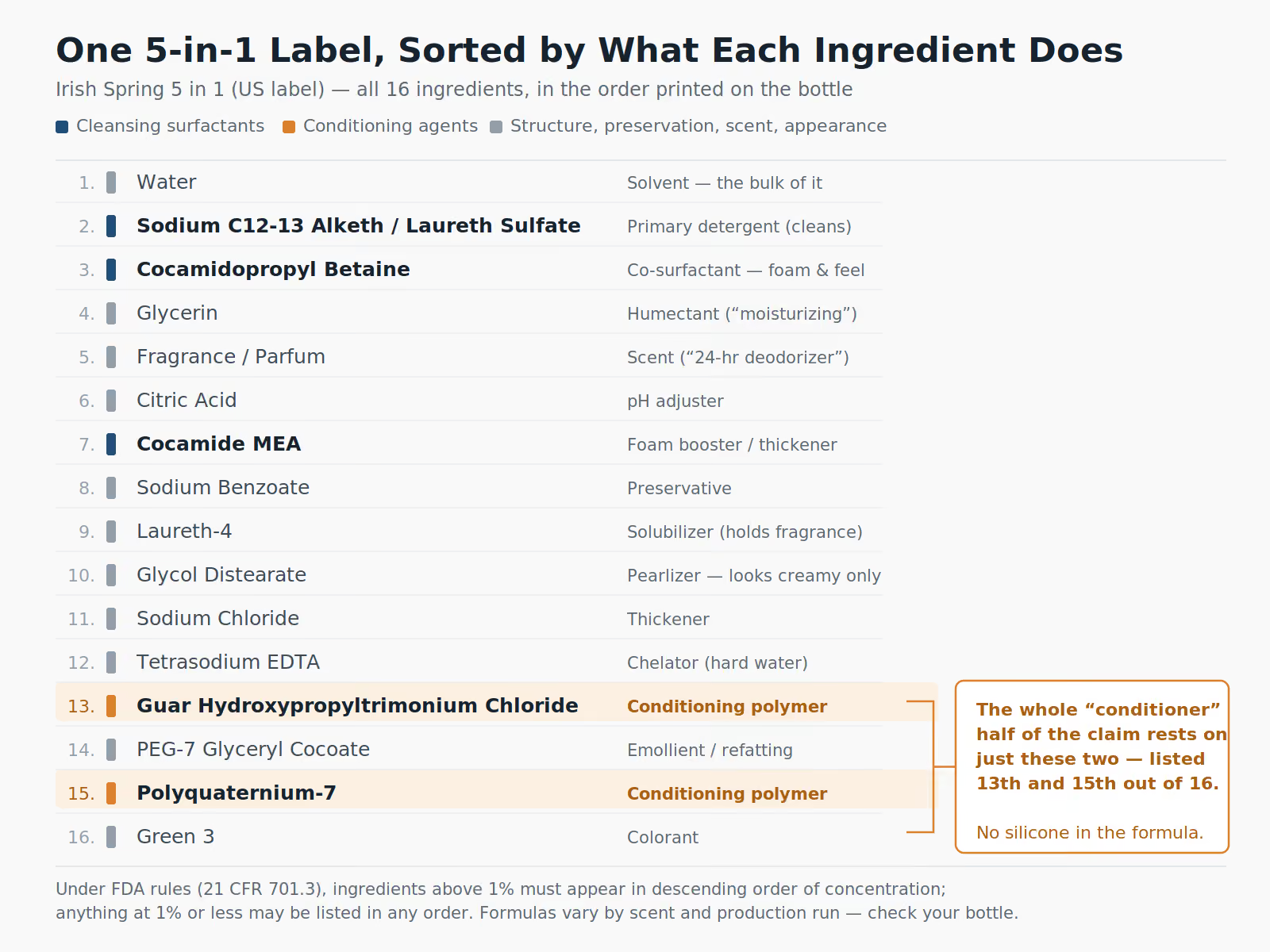
Read a real 5-in-1 label and the five promises collapse into about four functional groups. Take Irish Spring’s 5-in-1, sold as shampoo, conditioner, body wash, face wash and 24-hour deodorizer. As printed on the US label, here is what each part is actually for.
The cleaning. Sodium C12-13 alketh sulfate (or sodium laureth sulfate) is the primary anionic detergent. Cocamidopropyl betaine is the amphoteric co-surfactant that thickens the mix, boosts foam and blunts the harshness of the primary. It is also the American Contact Dermatitis Society’s 2004 Allergen of the Year — not because the molecule is aggressive, but because manufacturing impurities such as amidoamine are. In North American patch-test data, the most common site of reaction was the head and neck. Cocamide MEA rounds out the group as a foam booster and thickener.
The conditioning. Guar hydroxypropyltrimonium chloride and polyquaternium-7. Two cationic polymers, both coacervate formers, both listed below tetrasodium EDTA — which is to say below the one percent line. Under 21 CFR 701.3, anything above one percent must appear in descending order of concentration; at or below that, order is optional. There is no silicone in this formula at all.
The feel, and the marketing. Glycerin is a humectant and carries the moisturizing claim. Glycol distearate is a pearlising agent — it makes the liquid look creamy and does nothing to your hair or skin. Laureth-4 keeps fragrance dissolved. Sodium chloride and citric acid set thickness and pH. Tetrasodium EDTA stops hard water forming scum. Sodium benzoate preserves it. Green 3 colours it.
And the fifth promise? The 24-hour deodorizer is fragrance — no antiperspirant active, no antimicrobial. The brand’s own FAQ page does advise against using an ordinary body wash as shampoo, so the 5-in-1 is a genuinely different formula. Just a smaller difference than five bullet points imply.
Two absences matter more than anything present. There is no anti-dandruff active — no zinc pyrithione, ketoconazole or piroctone olamine — so a 5-in-1 is not a scalp treatment. And formulas vary by scent and production run: a second listing for the same brand swaps in sodium salicylate. Check your bottle, not an article.
Contact time is the one variable you control, so use it. Everything else was decided in a lab. How long the lather stays on your head was not.
Dermatology’s objection is less about the bottle count and more about matching the surfactant to the surface. A 2015 review in the Indian Journal of Dermatology by D’Souza and Rathi sets out what a shampoo contains — detergents, conditioners, thickeners, pH adjusters, preservatives and specialty additives — and makes the point that conditioning is already part of a shampoo’s job. A hybrid is not heretical.
Where dermatology gets pointed is pH. Gavazzoni Dias and colleagues measured 123 shampoos and found a range from 3.5 to 9.0, with only 38% at or below pH 5.5. Alkaline pH increases the negative charge on the fibre surface, which increases friction between fibres, which is how cuticles chip and hair breaks. Skin has a parallel problem: Lambers and colleagues, measuring 330 people, estimated natural skin surface pH at about 4.7 and found skin below pH 5 in better condition on barrier, moisturisation and scaling measures. A single formula has to pick one pH and live with it across scalp, face and body.
The alternative hair-care world reaches the same conclusion from the opposite direction. Co-washing — cleansing with conditioner instead of shampoo — is the mirror image of a 5-in-1: one product, weighted toward conditioning rather than cleaning. A 2019 paper in Skin Appendage Disorders is even-handed about it. Co-washing is gentle on the fibre, but it can leave residue under the cuticle scales and produce visible build-up. Proponents suggest that people with dry, curly or textured hair do better lowering surfactant exposure than adding conditioner back afterwards.
The shared insight across both camps is the interesting part. One product cannot optimise cleaning and conditioning at the same time. The 5-in-1 crowd accepts weak conditioning to keep strong cleaning. The co-wash crowd accepts weak cleaning to keep strong conditioning. Neither gets both, and neither pretends otherwise once you read past the front label.
The men’s grooming corner of TikTok and YouTube has turned the all-in-one bottle into an identity marker. Popular creators in the simplify-your-routine genre often frame a single bottle as evidence of low-maintenance competence, and the counter-genre — dermatologists and cosmetic chemists with large followings — reliably pushes back, usually on the grounds that the conditioning is nominal rather than that the product is harmful.
A contrasting current runs through the barber and curly-hair communities, where the advice is close to the inverse: more conditioner, less detergent, never the same product on scalp and ends. Both camps argue from lived results, and both are partly right, because they have different hair.
What almost nobody in either camp does is read the ingredient order. It settles most of the argument in about ten seconds.
The “5” is claim architecture, not five technologies. One surfactant base cleans hair, face and body — three claims from a single ingredient. Fragrance supplies the fourth. Under one percent of cationic polymer supplies the fifth. Nothing was added to make five things happen; five things were named on top of what a competent body wash already does.
That is not fraud, and these are not bad products. The coacervate deposition is real, measurable, and for short hair it is enough. But the marketing invites a substitution the chemistry does not support — that this replaces a conditioner. It partially does, weakly, for a few seconds. The gap widens exactly as hair gets longer, drier and more damaged — which is to say, for the people most likely to notice.
The quieter distortion is the face-wash claim. Facial skin is thinner, more frequently sensitised, and the site where the most common co-surfactant allergen turns up most often. Putting the same detergent on your scalp, your shoulders and your eyelids is a convenience decision, not a dermatological one.
Milder co-surfactants engineered without the allergenic manufacturing impurities are already moving through the literature and could remove the face-use caveat entirely. Better deposition polymers — higher charge density, tuned to release under shorter contact times — would narrow the conditioning gap honestly rather than rhetorically. And the field still lacks the study that would settle this: a blinded head-to-head of a 5-in-1 against a matched shampoo-plus-conditioner routine, measured over weeks rather than a single wash.
Credibility Rating: 6/10
👉 Who should try this: Anyone with hair shorter than about four inches, undamaged and uncoloured, who washes most days and wants fewer bottles. Excellent for travel and gym bags.
👉 Who should skip this: Anyone with long, curly, coily, bleached or chemically treated hair, an itchy or flaking scalp, or a history of reacting to facial cleansers.
⚕️ LyfeiQ Score: 6/10 — A fair trade if your hair is short and your standards are practical. Keep a separate conditioner if your hair is longer than your collar.
Disclaimer: This content includes personal opinions and interpretations based on available sources and should not replace medical advice. This content includes interpretation of available research and should not replace medical advice. Although the data found in this blog and infographic has been produced and processed from sources believed to be reliable, no warranty expressed or implied can be made regarding the accuracy, completeness, legality or reliability of any such information. This disclaimer applies to any uses of the information whether isolated or aggregate uses thereof.