
September 30, 2026
9 min
Nathan D
July 20, 2026
6 min
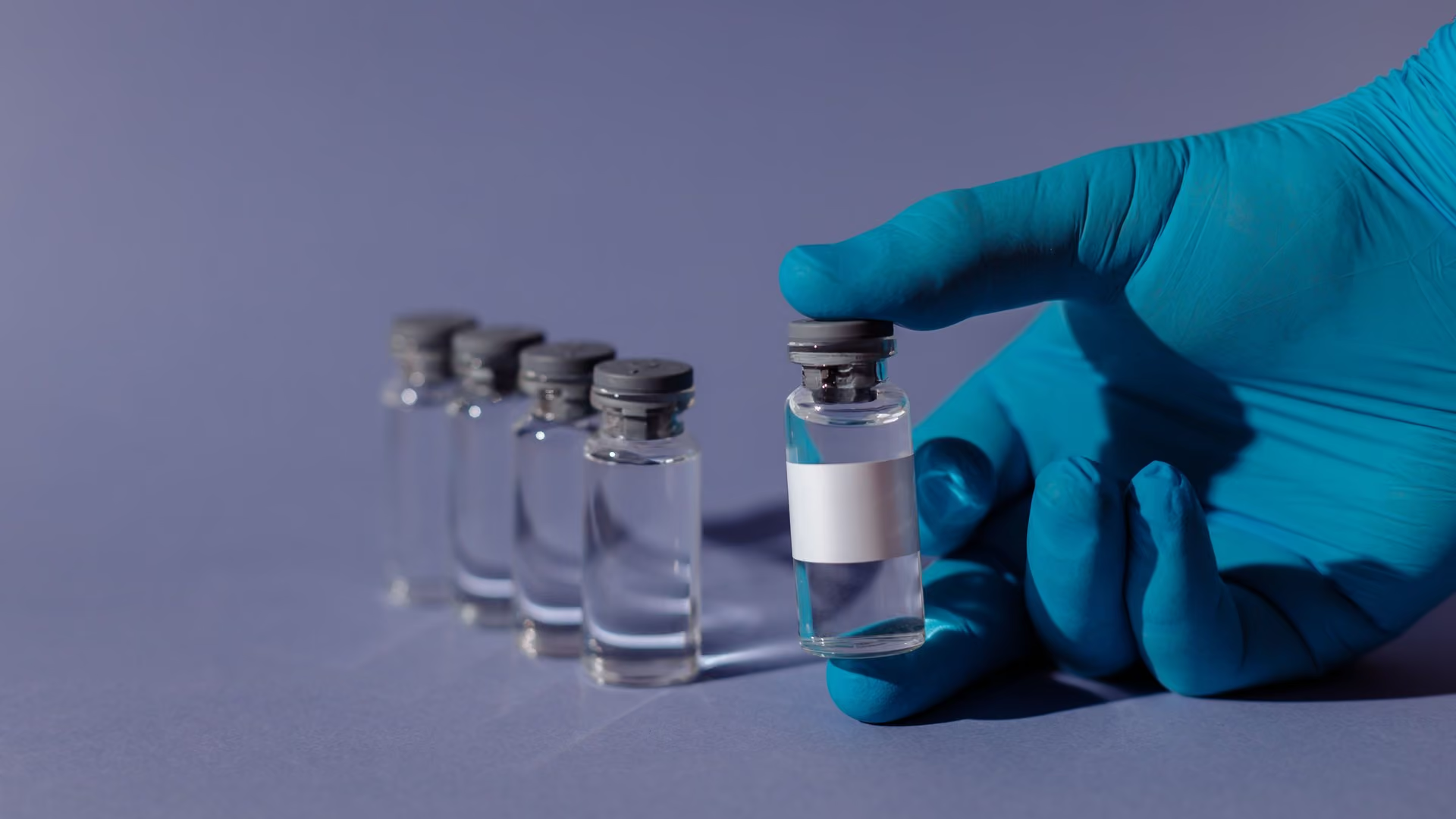
Give a person a sugar pill, tell them it’s medicine, and a measurable fraction of them will feel better — sometimes with real changes in their brain chemistry. That isn’t a trick of a weak mind. It’s one of the most reliably reproduced findings in medicine, and it’s also why a glowing testimonial for a supplement or peptide tells you almost nothing about whether the compound did anything at all.
What’s actually true: The placebo effect is real and physiological. Expectation alone can release the body’s own opioids and dopamine, and it reliably eases subjective symptoms like pain, nausea, and low mood. That’s the reason every serious drug trial has to beat a placebo, not just beat nothing.
What’s misleading or unregulated: The measured effect is modest and shows up mostly in how people feel, not in objective disease markers — and much of what gets called “placebo” is really the illness fading on its own. A personal “it worked for me” can’t separate a supplement or peptide from expectation, natural recovery, or chance, and these products never had to pass the placebo-controlled test that approved drugs do.
The placebo effect is what happens when a treatment with no active ingredient produces a real, measurable improvement in how someone feels. The word comes from the Latin for “I shall please,” and for a long time physicians used placebos to do exactly that — to please a patient without pharmacology. What changed is that researchers stopped treating the response as an embarrassment and started measuring it. When they did, they found something stranger than a polite fiction: under the right conditions, believing you are being treated can change your body.
The clearest evidence comes from pain. In 1978, a team led by Jon Levine at the University of California, San Francisco gave dental-surgery patients a placebo and then blocked their opioid system with naloxone — the same drug paramedics use to reverse an overdose. The patients whose pain had eased on the placebo got worse once the blocker was on board. That meant the relief had been running on the body’s own endorphins. It is the reason we can say placebo pain relief is not imagination; it is endogenous opioid release you can switch off pharmacologically.
Two decades later, brain imaging pushed the point further. Researchers at the University of British Columbia scanned Parkinson’s patients after an inert injection the patients believed was their medication, and watched the striatum flood with dopamine — the very neurotransmitter Parkinson’s depletes. Expectation of relief, not any drug, triggered the release. Different symptoms recruit different systems: opioids for pain, dopamine for reward and movement, other circuits besides. The common thread is expectation.
The next finding unsettles most people. You might assume the effect depends on the patient being fooled. It doesn’t. In a 2010 Harvard trial, Ted Kaptchuk’s group gave patients with irritable bowel syndrome pills they were openly told were an inert substance, like sugar pills — and those patients still improved more than patients given nothing. A later trial repeated the result in children with abdominal pain, who also needed less rescue medication. The ritual of taking something, in a convincing clinical setting, appears to do part of the work on its own.
So the placebo effect is real. Real is not the same as powerful, and this is where a careful reading matters. In 2001, the Danish researchers Asbjørn Hróbjartsson and Peter Gøtzsche did something placebo enthusiasts mostly hadn’t: they pooled trials that included a true no-treatment group, so they could compare placebo against simply leaving the illness alone. Across 130 trials, placebo had no significant effect on objective measurements — blood pressure, cholesterol, whether a wound healed. On symptoms patients rated themselves, especially pain, there was a small benefit: about 6.5 millimeters on a 100-millimeter pain scale. An update three years later, covering more than 11,000 patients, reached the same conclusion, and cautioned that even that modest effect was hard to separate from ordinary bias.
The reason that matters: much of what looks like a treatment working is not placebo at all. Most symptoms rise and fall on their own. People tend to seek help when they feel worst, and things drift back toward average afterward whether or not they did anything — a statistical fact called regression to the mean. Colds resolve. Flares subside. Add the natural human wish to feel that a decision paid off, and you have a reliable engine for producing “it worked” stories that have nothing to do with the pill.
This is where supplements and peptides get interesting. A prescription drug, before it can be sold in the United States, has to show what the FDA calls substantial evidence of effectiveness — and the agency’s own rules spell out why: a trial must be able to distinguish the drug’s effect from “spontaneous change in the course of the disease, placebo effect, or biased observation.” That sentence is the whole game. It is an admission, written into federal regulation, that people get better for reasons unrelated to the medicine, and that the only way to know whether a compound works is to subtract those reasons out.
Dietary supplements don’t have to clear that bar. Under the 1994 law that governs them, the FDA does not approve supplements for effectiveness before they’re sold; a company is responsible for its own claims, and a “supports healthy joints”-style statement has to carry a disclaimer that the FDA hasn’t evaluated it. The wellness peptides sold for recovery, fat loss, and “longevity” sit even further outside the system. Compounds like BPC-157 are not approved drugs and fall outside the rules for pharmacy compounding; a peer-reviewed review notes they lack the human clinical studies that would confirm a benefit, and many are sold as “research chemicals” not intended for human use. Whatever their eventual merits, almost none have been through the placebo-controlled human trials that would tell you whether the reported effect is the molecule or the expectation of the molecule.
Which is not a claim that these products do nothing. It is a claim that you cannot tell from the evidence usually offered. The testimonial, the before-and-after photo, the “I felt sharper within a week” — those are the exact signature of expectation plus natural variation plus the wish to have chosen well. Sellers lean on them because they are persuasive and cheap; a real trial is neither. Some companies do fund honest research, and some clinicians are candid that a given peptide is experimental. But the marketplace as a whole runs on precisely the kind of evidence the placebo effect is built to imitate.
None of this makes the placebo response a reason for despair, and it is no reason to feel foolish for having experienced it. The relief is real; the brain chemistry is real. What’s unsettled is how far the effect reaches and how long it lasts. The open-label results hint that expectation and ritual might be harnessed honestly, without deception — an active area of research. What no one has shown is a placebo shrinking a tumor, clearing an infection, or repairing tissue. It changes the experience of illness far more reliably than the biology of it.
So the practical takeaway is narrow and durable. When you feel better after starting something new, that feeling is trustworthy as a feeling and unreliable as evidence. The two questions worth asking about any supplement or peptide are whether it has been tested against a placebo in people, and who paid for the test. If the only proof on offer is how it made someone feel, you have learned something about the placebo effect — not about the product. And with unapproved injectables in particular, the sensible next step is a licensed prescriber or pharmacist, not a checkout cart.
Disclaimer: This content includes personal opinions and interpretations based on available sources and should not replace medical advice. This content includes interpretation of available research and should not replace medical advice. Although the data found in this blog and infographic has been produced and processed from sources believed to be reliable, no warranty expressed or implied can be made regarding the accuracy, completeness, legality or reliability of any such information. This disclaimer applies to any uses of the information whether isolated or aggregate uses thereof.