

September 30, 2026
9 min
Kenneth D
October 2, 2026
6 min

You spend your forties watching hair thin on top of your head — and then it sprouts, seemingly overnight, from your ears and nose. It feels like a cruel joke. It is actually one hormone, doing two opposite things.
What’s actually true: The ear, nose, and eyebrow hair that thickens with age is driven by the very same androgen — dihydrotestosterone (DHT) — that thins the scalp. The follicles simply respond in opposite directions, and this is a normal part of aging for both men and women, not a sign that something is wrong.
What’s misleading or unregulated: The grooming industry sells “permanent” laser removal and toxin-flushing gadgets, but the FDA reserves the phrase permanent removal for one method most people never consider — and the quick fix most reach for, plucking, is the one dermatologists warn against.
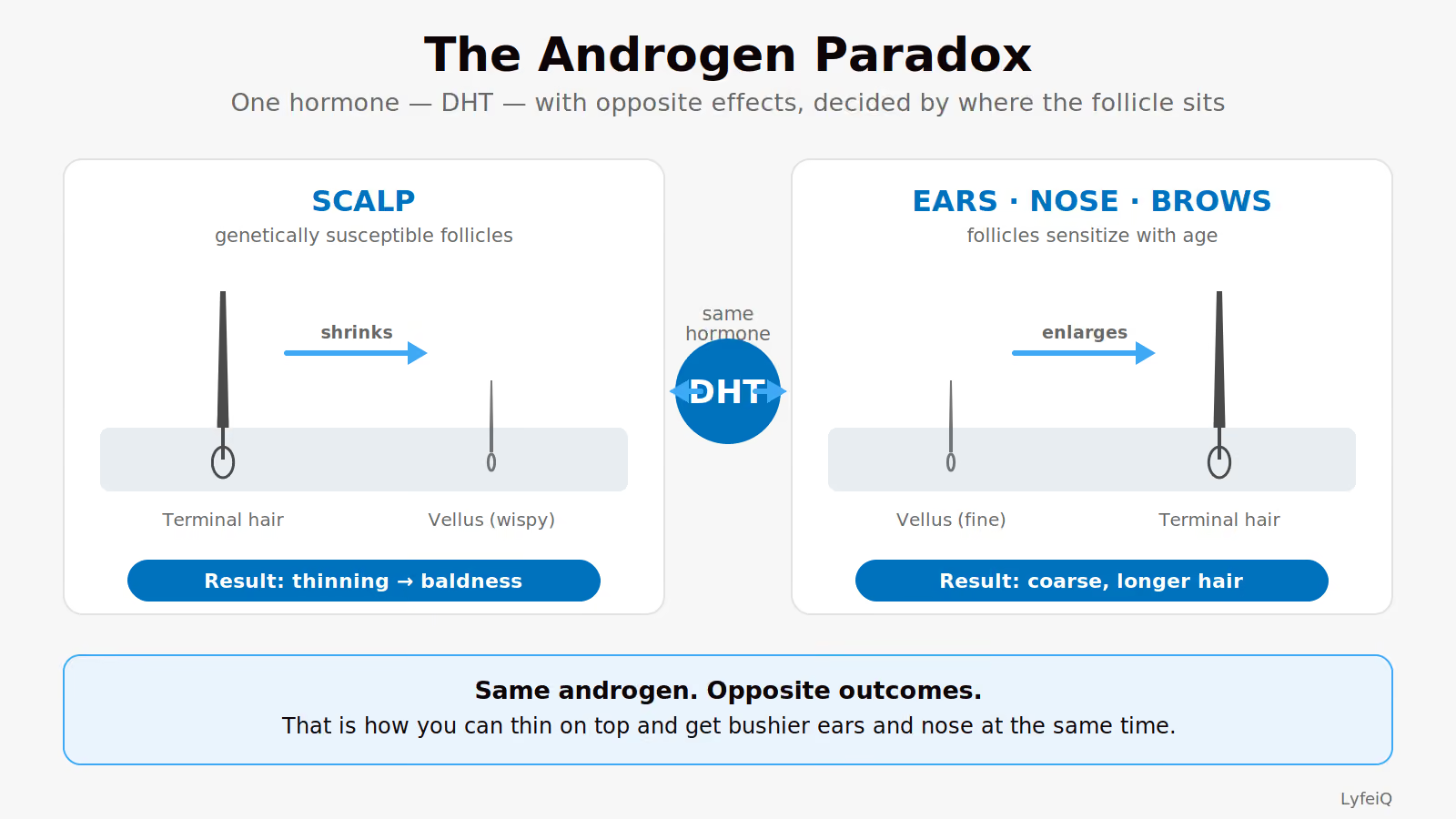
The same hormone that empties the top of your head fills in your ears. To see why, you have to know that not all hair is the same. Fine, pale, barely-there fuzz is called vellus hair; the thick, dark, long stuff is terminal hair. Whether a follicle grows one or the other is governed largely by androgens — testosterone and, especially, its more potent cousin dihydrotestosterone, or DHT, which the body makes from testosterone using an enzyme called 5-alpha reductase.
Now the strange part. In some places, androgens turn vellus hair into terminal hair. In others — the scalp of anyone genetically prone to pattern baldness — the same androgens do the reverse, shrinking terminal follicles back down until they produce wispy vellus hair or nothing at all. Dermatologists literally call this the androgen paradox: one hormone, opposite outcomes, decided entirely by the local follicle.
Age is what tips the ears and nose into the growth column. Over decades, the follicles inside your ear canals, nostrils, and eyebrows appear to grow more sensitive to androgens, extending the phase in which hair actively grows so strands get longer and coarser. There is a supporting cast: a blood protein called sex hormone-binding globulin (SHBG), which normally keeps testosterone locked up, tends to shift with age in ways that leave more of it free to act on those follicles. The upshot is that even as a man’s overall testosterone drifts downward after midlife, the hair in exactly the wrong places keeps getting bushier. Ear-canal hair is the slow poke of the group — some of it takes as long as 30 years of exposure to fully turn.
Women run the same machinery on a different schedule. Through the reproductive years, estrogen keeps androgens in check. At menopause, estrogen drops sharply while androgens decline only gradually, so the ratio tips — and a handful of coarse hairs on the chin or upper lip is a common, normal result, not a personal failing. The underlying hormone biology is identical to the male version; women simply get far less of the ear-and-nose form because their androgen levels are lower to begin with. One thing is worth flagging: if new coarse hair appears suddenly and fast — especially alongside irregular periods, a deepening voice, or rapid changes elsewhere — that is a reason to see a doctor, because it can point to conditions like polycystic ovary syndrome or, rarely, a hormone-producing tumor. The everyday chin hair of your fifties is not that. Sudden and dramatic is the signal; slow and gradual is just biology.
So why did evolution leave hair in your nose at all? The nose hairs have a real job. Those stiff strands — vibrissae — are a coarse air filter, trapping dust, pollen, and larger airborne particles before they reach the lungs. It is more than a nice theory: a 2011 study of people with seasonal allergies found that those with fewer nasal hairs were more likely to have asthma, presumably because less filtering meant more allergens reaching the airway. Ear hair is murkier; scientists can point to some barrier function against dust and insects but have never landed on a tidy purpose. And the specific question you are actually asking — why this hair proliferates precisely when you are old enough to no longer need to impress anyone — has no satisfying evolutionary answer. The most honest read is that it is not an adaptation at all, just a side effect of follicles marinating in androgens for fifty years.
Which brings us to what people actually do about it — and where the marketing gets slippery. The safest move is also the most boring: trim, do not pluck. Yanking a nose hair out by the root leaves a tiny wound in a spot thick with bacteria, and the nose sits inside the so-called danger triangle of the face, where veins connect toward the brain. Serious infections from this are genuinely rare, but nasal vestibulitis and painful ingrown hairs are not, and the filtering function is worth keeping. Trimming shortens the eyesore without ripping out the filter.
The removal industry, meanwhile, leans hard on one word: permanent. It is worth knowing what the regulator actually allows that word to mean. The FDA clears — it does not “approve” — laser devices, and the claim it clears them for is “permanent hair reduction,” which its own paperwork defines as a stable, long-term drop in the number of regrowing hairs, not their elimination. The only method the agency associates with the phrase permanent hair removal is electrolysis — the slow, one-follicle-at-a-time technique most people have never tried. There is a further catch that matters specifically for aging hair: lasers work by targeting pigment, so they struggle with exactly the gray and white hairs that show up as you get older. As for the one anti-hair-growth drug the FDA has actually approved — eflornithine cream, cleared back in 2000 — it only slows growth rather than removing hair, it must be used indefinitely, and it was approved solely for unwanted facial hair in women, not for anyone’s ears or nose.
That gap points to the real punchline. There has never been more money chasing hair: a wave of new drugs — the topical anti-androgen clascoterone posted large late-stage results in late 2025 — is racing toward the market. But look at what all of it is for. Nearly the entire pipeline, and the multibillion-dollar industry behind it, is aimed at putting hair back on balding scalps. Almost nothing is being developed to reduce the hair people plainly do not want. So when a gadget or clinic promises to “prevent” age-related ear and nose hair, treat it skeptically: there is no approved treatment that prevents it, and no serious pipeline building one. What exists is management — trimming, reduction, or removal — not prevention.
None of which makes the hair a problem to be ashamed of. It is a normal marker of a body that has been doing its job for decades, and in the case of your nose, still is. The most useful thing to know is not how to wage war on it. It is that the same hormone is quietly rearranging your whole scalp-to-nostril map, that “permanent” on a laser ad means less than it sounds, and that the fix nobody advertises — leaving the filter in place and reaching for trimmers instead of tweezers — is usually the right one.
Related: Why “Clinically Proven” Isn’t the Same as Statistically Significant
Disclaimer: This content includes personal opinions and interpretations based on available sources and should not replace medical advice. This content includes interpretation of available research and should not replace medical advice. Although the data found in this blog and infographic has been produced and processed from sources believed to be reliable, no warranty expressed or implied can be made regarding the accuracy, completeness, legality or reliability of any such information. This disclaimer applies to any uses of the information whether isolated or aggregate uses thereof.