August 24, 2026
10 min
Maya Q.
July 20, 2026
8 min
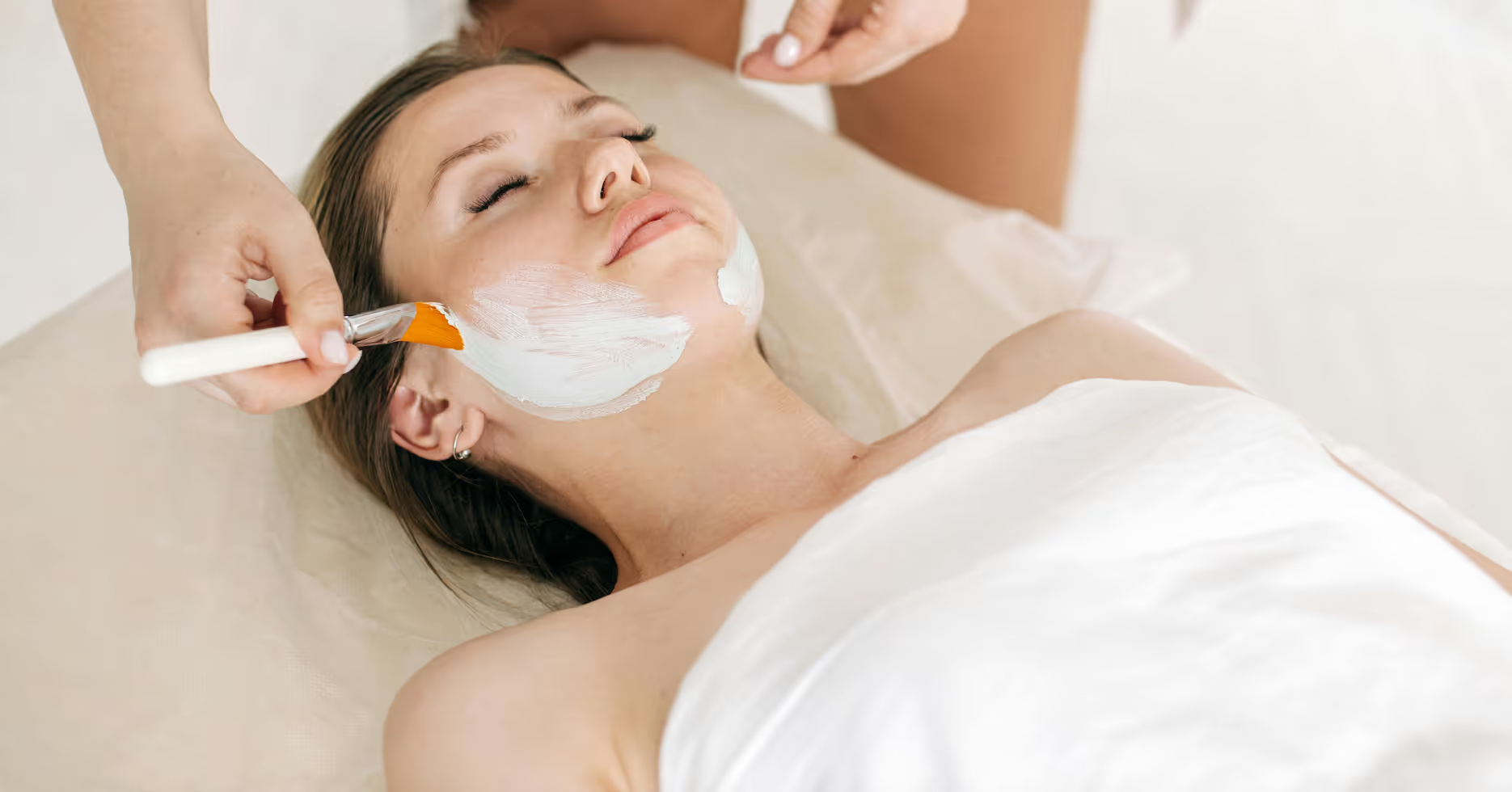
Walk into any beauty aisle today and you’re surrounded by serums promising one thing: peptides. They’re marketed as molecular coaches that signal your skin to rebuild itself — collagen on demand, wrinkles reversed, aging slowed. But the gap between what the science actually shows and what the packaging implies is wider than most consumers realize.
✅ What the evidence supports: Topical peptides — particularly palmitoyl pentapeptide-4 and copper tripeptide — have demonstrated modest improvements in skin hydration, texture, and wrinkle depth in controlled clinical trials. They are well-tolerated and low-risk for most skin types. ⚠️ What’s overstated: Most peptides don’t penetrate deeply enough to stimulate dermal collagen production at scale. The dramatic anti-aging effects shown in marketing materials reflect ideal conditions — often including other actives, professional lighting, or industry-funded trials — not the realistic standalone performance of peptides alone. ⚕️ LyfeiQ Score: 6/10 — Peptides are worth including in a well-rounded routine, but they are a supporting player, not the headliner. Don’t pay premium prices expecting retinoid-level results.
Peptides are among the most biologically plausible ingredients in skincare — and also among the most overhyped. As signaling molecules, they instruct cells to perform specific functions: produce collagen, repair tissue, dampen inflammation. Fields et al. (2009) laid out the theoretical promise clearly in the Journal of Cosmetic Dermatology, describing how bioactive peptide analogs can be engineered to target virtually any aspect of skin homeostasis.
In practice, the clinical evidence is real but modest. Palmitoyl pentapeptide-4 (sold commercially as Matrixyl) has been among the most studied, with trials recording measurable reductions in wrinkle depth and improvements in skin texture after several weeks of consistent use. Copper peptides — the GHK-Cu tripeptide in particular — have demonstrated wound-healing and tissue-repair properties, with Pickart and Margolina (2018) documenting their influence on gene expression pathways related to collagen synthesis and antioxidant activity.
The comprehensive review by Gorouhi and Maibach (2009) in the International Journal of Cosmetic Science remains the field’s most thorough audit of topical peptide evidence, categorizing them into four functional groups: signal peptides, carrier peptides, enzyme-inhibiting peptides, and neurotransmitter-inhibiting peptides. Their conclusion was careful: improvements are statistically significant in controlled settings, but effect sizes are generally modest, and most trials are small, short, and industry-sponsored.
Schagen’s 2017 review in Cosmetics reinforced this picture — some peptides have earned their place through controlled in vivo studies, but for many others, the evidence sits in supplier brochures rather than peer-reviewed journals.
If you’re going to invest in a peptide product, how you use it matters as much as which one you choose. Peptides are best applied after cleansing and any water-based serums, before heavier moisturizers. They work well alongside hyaluronic acid and niacinamide, but avoid pairing with direct acids in the same step — low pH can degrade some peptide formulations.
Consistency beats concentration. Unlike retinoids, which can show results in weeks, peptides tend to show cumulative benefits over 8–12 weeks of daily use. Don’t judge them by a two-week test. The clinical trials that show positive results for peptides almost always test them in multi-ingredient formulations, so pairing peptides with antioxidants or barrier-support ingredients appears to improve outcomes.
Safety profile is strong. Peptides are among the gentlest actives available and are generally appropriate for sensitive skin, rosacea-prone skin, and people who can’t tolerate retinoids. Lintner and Peschard (2000) noted early on that the adaptability of peptide formulations makes them particularly attractive as retinoid alternatives.
The mainstream dermatology position on peptides is cautiously supportive — not dismissive, but firmly measured. Both the Mayo Clinic and Cleveland Clinic acknowledge that peptides can modestly improve the appearance of fine lines and support hydration, while being clear that they fall short of clinically proven treatments like topical retinoids, vitamin C, or professional procedures such as laser resurfacing and microneedling.
The key constraint dermatologists emphasize is skin penetration. The stratum corneum is a formidable barrier designed to keep large molecules out. Most peptides are hydrophilic and relatively large, which limits how deeply they can diffuse without delivery-enhancing technology. For peptides to stimulate fibroblasts in the dermis and meaningfully increase collagen production, they need to reach dermal layers — something most standard topical formulations cannot reliably achieve.
This is why the mainstream medical consensus positions peptides as useful adjuncts rather than primary anti-aging interventions. For patients who can’t tolerate retinoids due to sensitivity, pregnancy, or skin conditions, peptides represent a reasonable second-line option.
In holistic skincare communities, peptides are embraced as gentle, body-compatible collagen inducers — and the framing is often more expansive than the evidence warrants. The NCCIH acknowledges that bioactive compounds in skincare can support skin health through multiple mechanisms, and integrative practitioners frequently recommend peptides alongside oral collagen supplements and nutrient-dense diets to create what they describe as a whole-body rejuvenation approach.
The appeal is understandable: peptides are structurally similar to the body’s own signaling molecules, they’re not synthetic in the way preservatives or emulsifiers are, and their safety profile is genuinely excellent. Early studies in wound-healing contexts have long supported the tissue-repair capabilities of copper peptides, and this evidence is appropriately cited in integrative literature.
Where the claims overstep the science is in concepts like peptides “resetting cellular age” or delivering stem cell-like benefits. These phrases appear in product marketing and wellness content but have no peer-reviewed support. The distinction matters: peptides can support skin maintenance and minor repair; they cannot reverse fundamental aging biology.
On TikTok, Instagram, and YouTube, peptides have achieved near-mythological status — often tagged as “Botox in a bottle.” The framing taps into a widespread desire for injectable-level results without the needle, the cost, or the clinical appointment. Popular skincare creators on TikTok routinely post before-and-after comparisons crediting peptide serums with dramatic smoothing or lifting effects, while often omitting that multiple other actives are in the routine and lighting differences between shots can exaggerate results.
That said, not all influencer commentary is uncritical. Several prominent skincare educators on YouTube — including those with licensed aesthetician or dermatology backgrounds — have specifically addressed the gap between peptide marketing and evidence, noting that while peptides are legitimate ingredients, they’re unlikely to replace retinoids or professional treatments. This skeptical voice exists in the conversation; it’s simply less viral than the transformation content.
Peptides sit in an unusual position: they’re genuinely effective ingredients surrounded by genuinely inflated claims. The disconnect isn’t that peptides don’t work — they do, within real limits — it’s that the limits are almost never communicated in marketing.
The borrowed legitimacy problem is real. The wound-healing evidence for GHK-Cu copper peptides, developed largely in clinical and surgical contexts, gets recruited to support claims about cosmetic anti-aging. Industry-funded research dominates the published literature — this doesn’t automatically make findings invalid, but it does mean independent replication is rare, and effect sizes in sponsored trials tend to be more favorable than in independent studies. The methodological patchwork — different measurement tools, short durations, tiny sample sizes — makes comparing products nearly impossible for consumers.
The honest synthesis: peptides are a low-risk, low-irritation, genuinely active class of ingredient that can contribute meaningfully to a skin maintenance routine. They are not transformative on their own. Their ceiling of efficacy, without advanced delivery technology, sits well below retinoids and professional treatments. That’s not a reason to avoid them — it’s just the reality that marketing is designed to obscure.
Research is advancing on multiple fronts that could change the effectiveness calculus meaningfully. Scientists in South Korea and Japan — where cosmetic peptide science leads globally — are engineering synthetic peptide analogs with improved stability and bioactivity. Delivery systems including lipid nanocarriers, microemulsions, and microneedle-assisted application are showing early promise in getting peptides past the stratum corneum and into dermal tissue at concentrations sufficient to drive collagen synthesis. If these delivery technologies mature and scale, the clinical evidence base for topical peptides could look considerably different within a decade.
Credibility Rating: 6/10
👉 Who should try this: People building a comprehensive skincare routine who want a low-irritation active, particularly those sensitive to retinoids or looking to add a supporting ingredient alongside vitamin C or niacinamide. Peptides also make sense for anyone in their 30s–50s who wants to support collagen production over time.
👉 Who should skip this: Anyone expecting dramatic wrinkle reversal or injectable-comparable results will be disappointed. If your primary goal is meaningful structural skin change, invest first in a proven retinoid or consult a dermatologist about professional treatments. Peptides alone won’t get you there.
⚕️ LyfeiQ Score: 6/10 — Peptides are a legitimate, low-risk addition to a thoughtful skincare routine. Use them consistently, pair them with better-evidenced actives, and keep your expectations calibrated to what the science actually shows — incremental improvements, not transformations.
Related: The Collagen Paradox: Why Collagen Won’t Rebuild Your Collagen by Eating It
Disclaimer: This content includes personal opinions and interpretations based on available sources and should not replace medical advice. This content includes interpretation of available research and should not replace medical advice. Although the data found in this blog and infographic has been produced and processed from sources believed to be reliable, no warranty expressed or implied can be made regarding the accuracy, completeness, legality or reliability of any such information. This disclaimer applies to any uses of the information whether isolated or aggregate uses thereof.