
September 30, 2026
10 min
Kenneth D
October 2, 2026
6 min

In June 2026, a University of Florida study set off a wave of headlines warning that a supplement millions of people take for creaky knees might be accelerating dementia. The finding is real. The headline is missing an asterisk the size of a billboard.
What’s actually true: A 2026 study in Nature Metabolism found that in a brain already affected by Alzheimer’s, glucosamine can feed a metabolic process called hyperglycosylation — and in people with an existing dementia diagnosis, its use was linked to faster decline and higher mortality.
What’s misleading or unregulated: “Joint pill causes Alzheimer’s” flattens a conditional finding into a blanket one. In healthy people, the largest studies to date tie glucosamine to the same or lower dementia risk, and every human result so far is a statistical association, not proof.
The alarming version of this story is the one that traveled, so it’s the one worth taking apart first. What the University of Florida team actually reported is narrower and, honestly, more interesting than “supplement rots your brain.” Their paper is built on a mechanism — and the mechanism only misbehaves under a specific condition. That condition is a brain that already has Alzheimer’s disease.
Here’s how it works. In a healthy cell, glucose flows through a side route called the hexosamine pathway to build the sugar chains — glycans — that keep proteins folding, trafficking, and signaling correctly. It’s essential housekeeping. The UF team, in a study published in Nature Metabolism, used spatial imaging of both mouse brains and donated human brain tissue to show that in Alzheimer’s this housekeeping goes into overdrive: glycan production ramps up, and the excess — hyperglycosylation — tracks with disease severity across the stages of the illness.
Glucosamine matters because it is a raw material for exactly that pathway, and it crosses into the brain readily. Give it to a mouse whose brain is already over-producing glycans, and you pour fuel on the fire. In Alzheimer’s-model mice, glucosamine — at a dose scaled from an ordinary human amount of about 2,500 mg a day — worsened performance on memory tests and pushed brain glycan levels higher. Turn the pathway down instead, either genetically or with an enzyme-blocking drug, and the same mice’s memory improved.
Now the part that didn’t make the headlines. When the researchers fed the same glucosamine dose to healthy mice, nothing happened. No surge in brain glycans. No memory loss. The normal brain simply buffered it. Whatever makes glucosamine dangerous appears to require a brain whose metabolism has already come off the rails.
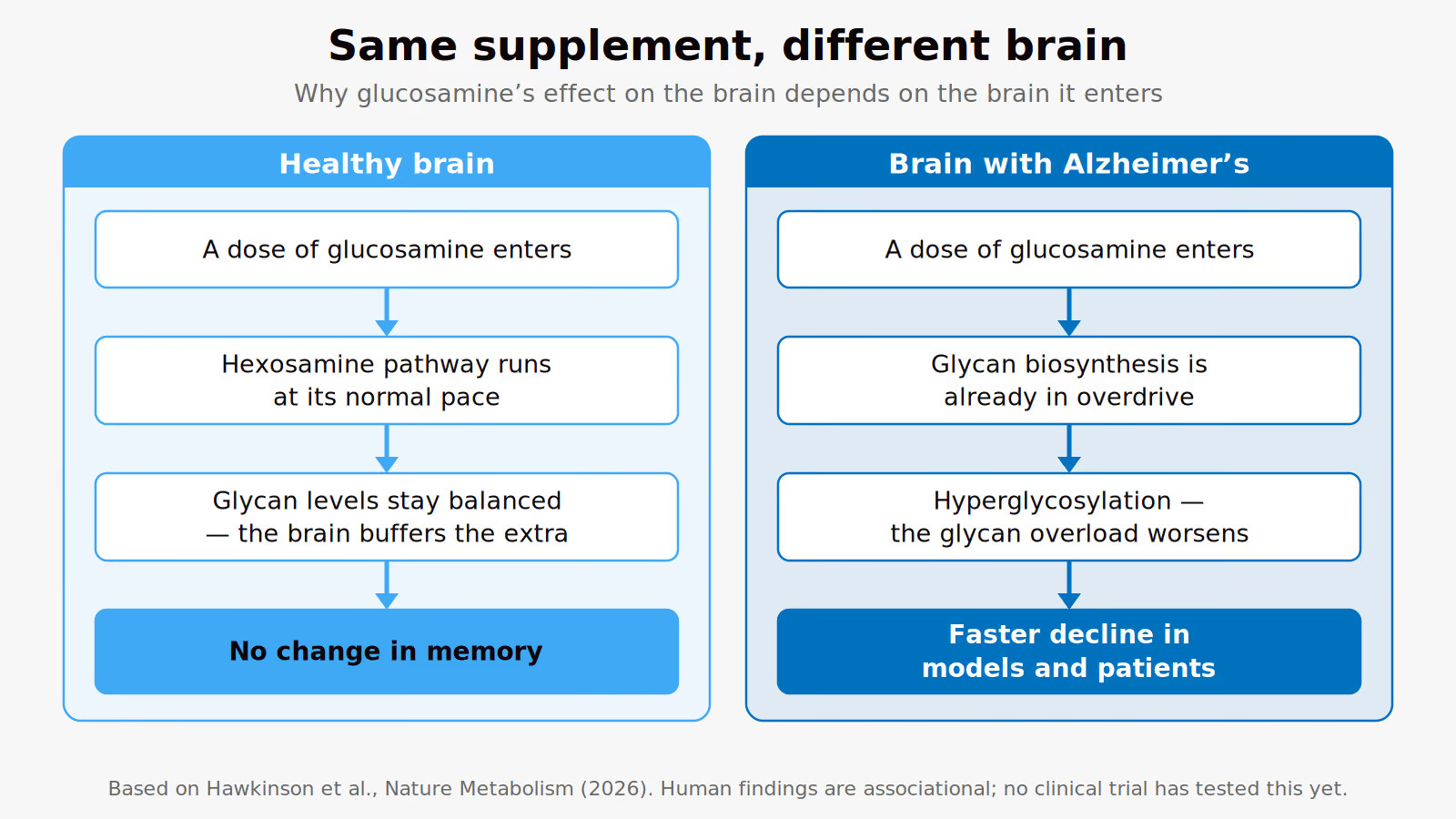
The human data follow the same split. Analyzing records from the University of Florida Health system — roughly 24,000 patients with Alzheimer’s or a related dementia and about 42,000 with mild cognitive impairment (MCI) — the team found that among people who already had dementia, glucosamine use was tied to about a 25% higher death rate over the follow-up. Among people with MCI who went on to develop Alzheimer’s, glucosamine users made that transition faster. But across the MCI group as a whole, glucosamine made no significant difference to survival. The signal clusters in people who are already sick, not in the broad population of aging supplement-takers.
So who, realistically, should care? If you’re a generally healthy adult taking glucosamine for your joints, this study is not about you, and the wider evidence is reassuring. Two large UK Biobank analyses — the ones often cited to sell glucosamine as a longevity aid — followed hundreds of thousands of dementia-free adults for years. One linked regular glucosamine use to lower rates of all-cause dementia, Alzheimer’s, and vascular dementia, with a genetic analysis in the same paper hinting the relationship might even be causal. The other, in adults over 60, found lower vascular-dementia risk and no association with Alzheimer’s either way. Those are not the fingerprints of a supplement that causes dementia.
The people the new study is genuinely speaking to are those who already have mild cognitive impairment or a dementia diagnosis — and the families and caregivers making decisions for them. If that’s your situation, the reasonable move is not to panic and not to quietly stop a supplement on your own, but to put it on the list for the next conversation with the prescribing doctor or pharmacist. There is no evidence yet on whether stopping glucosamine after a diagnosis changes anything, and abrupt do-it-yourself changes to a care regimen carry their own risks.
It helps to know how lightly this product is regulated to begin with. In the United States, glucosamine is a dietary supplement, not a drug. Under the 1994 law that governs supplements, the FDA does not review it for safety or effectiveness before it goes on sale, approves no disease claims, and can generally act only after a problem surfaces. The study’s authors make the same point bluntly, noting that glucosamine is loosely regulated and varies in quality and purity from bottle to bottle. That looseness cuts both ways: it is why no one had systematically examined glucosamine and dementia outcomes until now, and why the honest answer to “is my brand doing this?” is that nobody is checking.
The product itself is more varied than the single word “glucosamine” suggests. It is sold as glucosamine sulfate, glucosamine hydrochloride, and N-acetyl glucosamine — not interchangeable — sourced either from shellfish or from fermented grain, usually at 1,500 to 2,500 milligrams a day for osteoarthritis. It is one of the most popular supplements on earth, a market measured in billions of dollars. The dose the UF mice received was scaled from that ordinary human amount, which is part of why the finding drew attention: this was not a megadose stunt.
For years the marketing pressure ran the other direction. Off the back of those UK Biobank cohort studies, glucosamine picked up a second life as a supposed longevity and heart-health supplement — the pill that helps you live longer. Now the pendulum is swinging to the pill that gives you Alzheimer’s. Both are the same mistake wearing different clothes: reading a firm conclusion off an observational study that can reveal a pattern but cannot, on its own, prove the supplement caused it. The more responsible voices — including the study’s own authors — frame the finding as a reason to run a proper trial, not a reason to declare the case closed.
Strip away both the alarm and the reassurance, and here is where the evidence actually sits. Glucosamine does not look like a general cause of Alzheimer’s. It looks like it may be a problem for a brain that is already in trouble — plausibly harmful once neurodegeneration is underway, neutral or even protective before then. That is a real and useful distinction, and it is the one the headline erased.
What remains unknown is most of what matters. The human findings are associational; the researchers identified glucosamine use by combing medical records, a method that is coarse and cannot capture dose or how long someone truly took it. No one has tested whether stopping glucosamine after a diagnosis helps. And there has never been a randomized trial — the one experiment that could turn a strong hypothesis into an answer. The authors are calling for exactly that. The more consequential prize buried in the paper may not even be about the supplement: if runaway glycosylation really does drive Alzheimer’s, the enzymes that control it become a target worth chasing for future drugs.
Until that trial exists, the takeaway is not fear. It is context. A healthy person’s joint supplement is not a dementia sentence. For someone already living with cognitive decline, it is a fair question to raise with a doctor — no more, and no less.
Related: The Healing Power of Nature: How Nature Therapy Can Boost Your Well-Being
Disclaimer: This content includes personal opinions and interpretations based on available sources and should not replace medical advice. This content includes interpretation of available research and should not replace medical advice. Although the data found in this blog and infographic has been produced and processed from sources believed to be reliable, no warranty expressed or implied can be made regarding the accuracy, completeness, legality or reliability of any such information. This disclaimer applies to any uses of the information whether isolated or aggregate uses thereof.