
September 30, 2026
10 min
Kenneth D
October 1, 2026
10 min
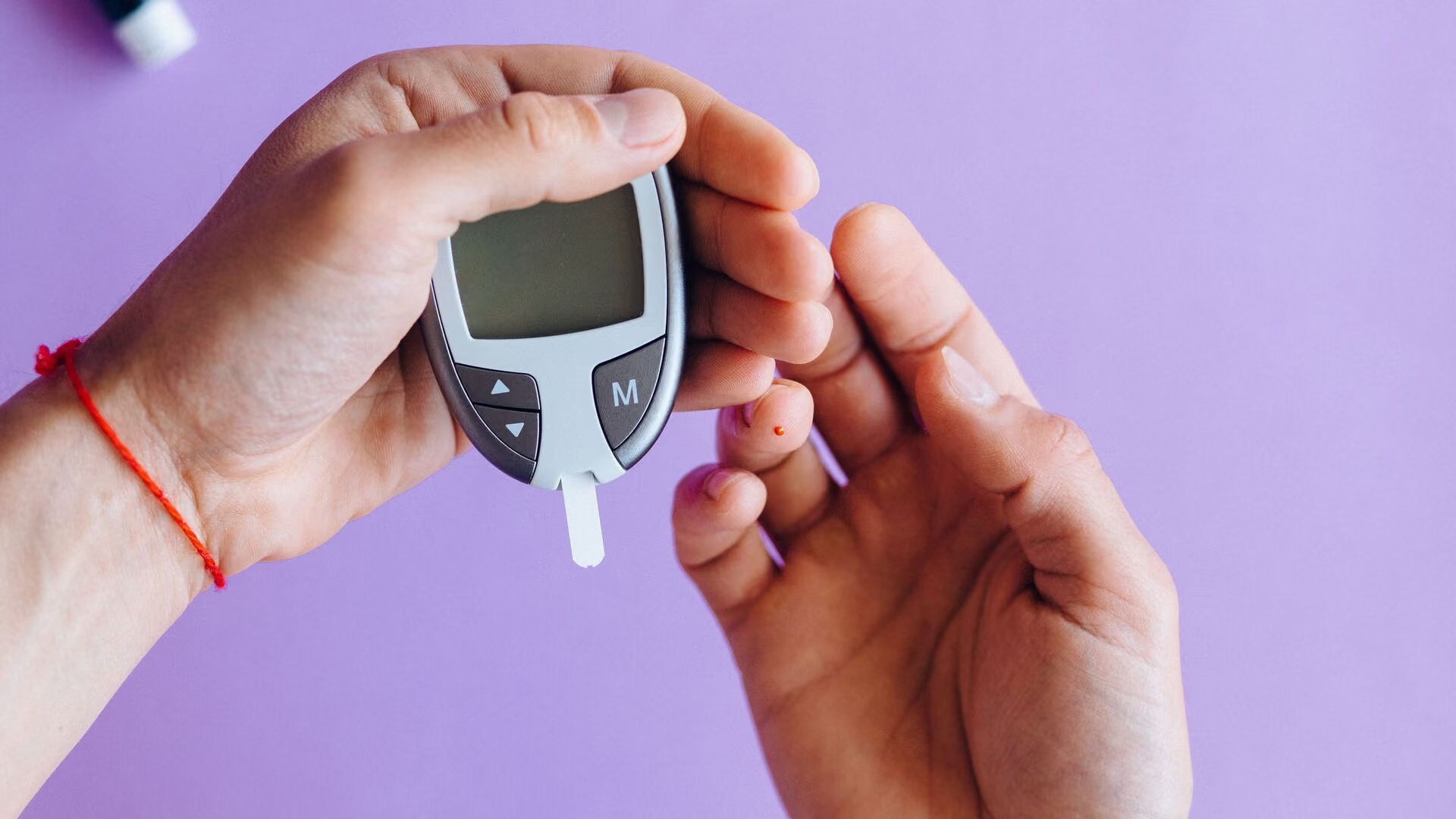
Berberine’s oral bioavailability is under 1 percent — almost none of an ingested dose reaches your bloodstream intact. And yet, trial after trial shows it blunting the blood sugar spike that follows a carbohydrate-heavy meal. The explanation has more to do with where berberine works than how much of it your body actually absorbs.
What the evidence supports: Meta-analyses of dozens of randomized trials show berberine measurably lowers blood glucose after meals, with a larger effect on postprandial (post-meal) glucose than on fasting glucose — consistent with a mechanism that acts locally in the gut.
What’s overstated or unsupported: Marketing berberine as ‘nature’s Ozempic’ or a stand-alone weight-loss fix. The effect is real but modest, most supporting trials were done in people who already had type 2 diabetes, and benefits appear to weaken with treatment beyond 90 days.
⚕️ LyfeiQ Score: 6/10 — a real, meal-timed effect worth a conversation with your doctor, not a replacement for prescribed treatment.
A 2019 meta-analysis pooling 28 randomized controlled trials and 2,313 people with type 2 diabetes found that berberine outperformed placebo on every major glucose marker — and the effect wasn’t evenly distributed. Fasting plasma glucose dropped by a weighted mean of 0.54 mmol/L. Postprandial (post-meal) glucose dropped by 0.94 mmol/L — nearly double. HbA1c fell by roughly 0.54 percentage points.
That asymmetry is the interesting part. If berberine worked mainly through the same routes as metformin — improving insulin sensitivity, suppressing liver glucose output — fasting and post-meal readings would likely move by similar amounts. Instead, the biggest effect shows up exactly when carbohydrates hit the gut.
The likely explanation is also the strangest fact about berberine: almost none of it gets absorbed. Pharmacokinetic reviews put its oral bioavailability under 1 percent in animal studies, with human plasma levels barely detectable even after a 500 mg dose. Most of what you swallow passes through the digestive tract largely intact.
So the action has to happen locally, and the mechanistic research backs that up. Berberine inhibits disaccharidase enzymes — sucrase, maltase — that break dietary starches and sugars down into absorbable glucose. Separately, a 2022 mouse study found it suppresses IGF-1R signaling that normally moves the GLUT2 glucose transporter to the brush border of intestinal cells, cutting the rate at which glucose crosses into the bloodstream in the first place. Slow the breakdown, block the doorway — less glucose gets through, and it gets through more slowly.
The mechanism isn’t fully settled, and it’s worth saying so. One cell-based study found that berberine increased glucose uptake in liver and muscle cells even when AMPK — the pathway most commonly credited with berberine’s effects — was pharmacologically blocked, pointing instead to inhibition of mitochondrial energy production as a separate driver. That’s a lab finding in isolated cells, not evidence about the gut mechanism above, but it’s a reminder that how berberine works is still an open question in places.
Timing matters more with berberine than with most supplements, because its main action happens at the moment carbohydrates are being digested. The protocol used in most clinical trials — and the one Cleveland Clinic recommends — is 500 milligrams taken two to three times daily, before meals, up to a maximum of about 1,500 mg per day. Berberine has a short half-life of only a few hours, so splitting doses across meals keeps levels active when carbohydrates actually arrive, rather than loading up once a day.
Start conservative. Gastrointestinal side effects — nausea, bloating, constipation, diarrhea — are the most common complaint, and they tend to improve when the dose is reduced.
Berberine is not for everyone. It’s contraindicated in pregnancy and breastfeeding, and it should never be given to infants — exposure has been linked to a dangerous buildup of bilirubin in newborns. It also interacts with drugs metabolized by the same liver enzymes it affects, including metformin, cyclosporine, omeprazole, and losartan — combining berberine with metformin or another glucose-lowering medication raises a real risk of blood sugar dropping too low. Anyone on prescription medication should talk to a doctor or pharmacist before adding it.
One more practical wrinkle: berberine supplements aren’t standardized the way trial formulations are. A bottle labeled ‘500 mg berberine HCl’ doesn’t guarantee the purity or extraction method used in the studies behind these numbers — a reason to favor brands that publish third-party testing, and to treat label claims with some skepticism.
Mainstream medicine treats berberine as a plausible, moderately effective supplement — not a substitute for prescribed care. Cleveland Clinic’s Dr. Layth Tumah has noted that berberine “in many ways, acts similarly to medication,” pointing to measurable effects on blood sugar, blood pressure, and lipids. That characterization lines up with the trial data: the 2019 meta-analysis and the gut-level mechanism research above both point to a real, reproducible glucose-lowering effect concentrated around meals. Cleveland Clinic still frames it as an adjunct at most, recommending medical supervision for anyone combining it with diabetes medication, given the interaction risk.
Integrative medicine sources are more openly skeptical than the mainstream framing above might suggest. The NIH’s National Center for Complementary and Integrative Health (NCCIH) describes the evidence as “inconclusive,” noting that benefits mostly showed up at doses above 1 gram daily sustained for eight or more weeks, and that many of the underlying studies carried a high risk of bias. Andrew Weil, M.D. — a longtime figure in integrative medicine — has been blunter still, writing that he isn’t “convinced that berberine is that fix,” and that “the evidence is just not there” to support the more ambitious claims circulating about it, while advising that it “should be used under a doctor’s supervision when used at all.” Even sources generally receptive to supplement-based approaches draw a hard line between a measurable effect and a proven solution.
On TikTok, berberine circulates almost exclusively as “nature’s Ozempic,” a comparison built for virality rather than accuracy. Creators have credited it with easy weight loss and blood sugar control requiring no other lifestyle changes, often while promoting a specific product. Not every creator is buying it: TikToker Carly Weinstein has pushed back publicly on the trend, calling out the businesses behind it for capitalizing on insecurity with what she frames as another unsustainable fad. Medical experts have been more precise about the gap: Harvard Medical School’s Dr. Caroline Apovian points to pooled trial data showing roughly a 0.25-point BMI reduction for berberine versus about 4.6 points for semaglutide — an order-of-magnitude difference dressed up as equivalence. “As for it being nature’s Ozempic,” Apovian said, “there’s no evidence to suggest that is true.”
All three perspectives agree on more than the online debate suggests: berberine has a real, gut-level, meal-timed effect on blood sugar. Mainstream and integrative sources point to the same trial data; they differ mainly on how confidently to state it, not on whether it exists. The disagreement sharpens around extrapolation — turning “measurable postprandial glucose reduction in people with type 2 diabetes” into “nature’s Ozempic” or “reverses insulin resistance” is where evidence gives way to marketing.
The size of that gap is worth sitting with. An 18-fold difference in BMI effect between berberine and semaglutide isn’t a rounding error — it’s a different category of intervention. Berberine’s mechanism (slowing carbohydrate digestion and absorption in the gut) and semaglutide’s (appetite suppression via GLP-1 receptor activity) aren’t even comparable pathways, and one is FDA-approved, precisely dosed, and physician-monitored; the other is a supplement bought off a shelf.
The other place worth separating fact from framing is supplement quality. Trial results come from controlled doses of a specific formulation. What’s sold at retail varies in purity, extraction method, and even actual berberine content — a gap the research almost never addresses, because researchers control what participants take and consumers don’t have that guarantee.
Three gaps stand out. Better-absorbed formulations — dihydroberberine, phospholipid complexes — are already being tested to see whether raising systemic exposure changes the postprandial effect, for better or worse, and whether it changes the interaction risk along with it. Most existing trials were conducted in Asian populations with existing type 2 diabetes, so data in prediabetic, metabolically healthy, or non-Asian populations remains thin — exactly the population most likely to be buying it as a supplement rather than taking it as treatment. And continuous glucose monitor studies, increasingly affordable for smaller trials, could map berberine’s postprandial effect meal-by-meal instead of relying on single fasting or two-hour snapshots — data that would speak directly to the question this article started with.
Relatedapamycin for Anti-Aging and Longevity: What Does Science Actually Say About This Controversial Drug?
Credibility Rating: 7/10
👉 Who should try this: Adults with prediabetes or mild insulin resistance who eat carbohydrate-heavy meals and want to test a meal-timed intervention under a doctor’s guidance, alongside standard lifestyle changes.
👉 Who should skip this: Anyone pregnant or breastfeeding, on metformin or other glucose-lowering or immunosuppressant medications without medical supervision, or looking for a substitute for prescribed diabetes treatment or GLP-1 drugs.
⚕️ LyfeiQ Score: 6/10 — The postprandial effect is real and mechanistically sound, but it’s a modest, meal-timed tool, not a metabolic overhaul. Talk to a clinician before adding it, especially if you take other medications.
Disclaimer: This content includes personal opinions and interpretations based on available sources and should not replace medical advice. This content includes interpretation of available research and should not replace medical advice. Although the data found in this blog and infographic has been produced and processed from sources believed to be reliable, no warranty expressed or implied can be made regarding the accuracy, completeness, legality or reliability of any such information. This disclaimer applies to any uses of the information whether isolated or aggregate uses thereof.