August 24, 2026
10 min
Nathan J
July 20, 2026
10 min
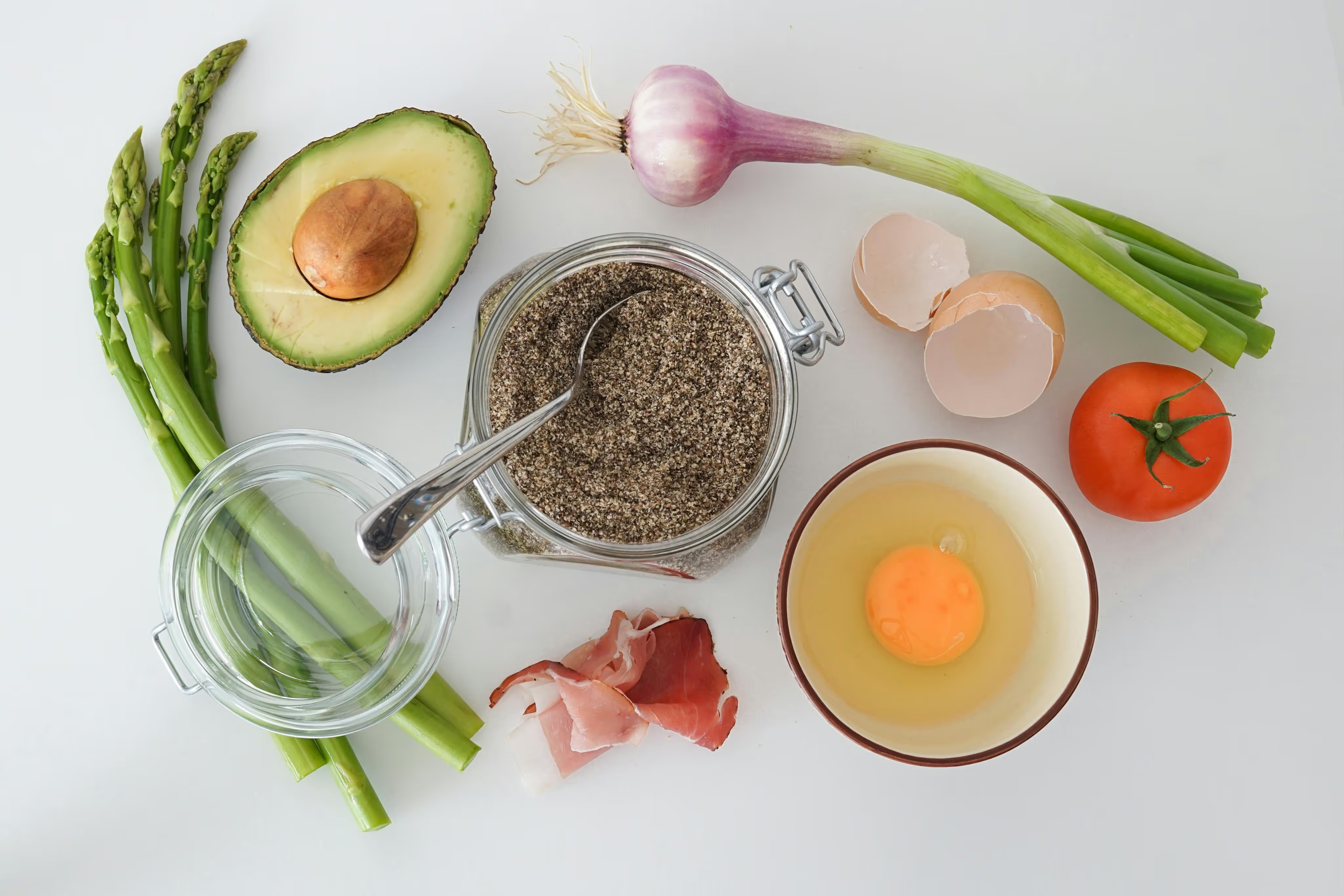
You flip over a box of crackers and the ingredient list reads like a chemistry exam: butylated hydroxytoluene, tocopherols, sodium benzoate. Your instinct says put it back. But what if the scariest-sounding ingredients are actually the ones keeping your food safe to eat? The gap between what sounds dangerous and what actually is dangerous might be wider than you think.
What the evidence supports: Approved food preservatives have decades of safety data behind them. Regulatory agencies set acceptable intake levels with 100-fold safety margins, and at typical dietary exposure, the risk of harm from preservatives is virtually nonexistent. The real public health risk they address, foodborne illness, kills thousands annually.
What’s overstated or unsupported: Claims that preservatives are “toxic” at normal dietary levels lack scientific backing. However, the long-term “cocktail effect” of multiple additives consumed together over decades remains understudied, and older rodent studies that fueled fears often had poor applicability to human biology.
LyfeiQ Score: 8.5/10 -- Preservatives are safe, well-tested, and necessary. The real issue is not what’s preserving your food but how much of your diet is ultra-processed in the first place.
The science of food preservation has evolved far beyond the ancient practice of salting meat, and the modern safety record is remarkably strong. Since the mid-2000s, food safety research has focused on a core principle: the dose makes the poison. A 2018 review in Nature reaffirmed that toxicity depends entirely on the amount consumed. Even water is lethal in extreme excess, yet the preservatives on your cracker box are present in microscopic quantities.
When you translate those intimidating chemical names, many are surprisingly familiar. Ascorbic acid is simply Vitamin C, used to prevent browning. Tocopherols are Vitamin E, which stops oils from going rancid. Potassium sorbate, a salt that inhibits yeast and mold, breaks down into water and carbon dioxide in your body according to the European Food Safety Authority (EFSA). Regulatory bodies like the FDA establish Acceptable Daily Intake (ADI) limits by identifying the level that causes zero harm in animal models and dividing by 100. You would need to consume thousands of servings of a preserved food daily to approach a concerning threshold.
However, the methods behind safety testing deserve a closer look. Most historical safety data comes from high-dose rodent studies. For instance, older research showed that BHA caused tumors in the forestomach of rats, but a 2020 review highlighted a significant flaw: humans do not have a forestomach. Our biology handles these compounds differently, meaning some legacy fears were built on shaky cross-species comparisons.
The valid open question is what researchers call the “cocktail effect.” Current testing evaluates additives individually, but most people consume multiple preservatives simultaneously over decades. While existing data suggests the cumulative risk is minimal, this remains an active research frontier. Studies on emulsifiers and gut microbiome disruption in animal models have added nuance, though human data at realistic dietary exposures is still limited.
The practical question is not whether preservatives are safe (they are, at dietary levels) but how to use ingredient labels wisely. First, stop using pronounceability as a safety test. Ascorbic acid, thiamine mononitrate, and alpha-tocopherol are vitamins. Dihydrogen monoxide is water. The name tells you nothing about the risk.
Instead, focus on the overall nutritional profile of the food. A product with preservatives but also whole grains, fiber, and minimal added sugar is a better choice than a “clean label” product that swapped chemicals for extra sugar and salt to compensate. If you want to reduce preservative exposure, prioritize fresh and frozen produce, buy smaller quantities more frequently, and cook from whole ingredients when practical. But do not feel guilty about the jar of salsa or the bread with calcium propionate. Those additives are there to keep you from getting sick.
For people with specific sensitivities, sulfites (found in wine, dried fruit, and some processed foods) are the most common preservative-related trigger, particularly for those with asthma. If you suspect a sensitivity, track symptoms and work with an allergist rather than eliminating entire food categories based on fear.
Major health institutions treat food preservatives as a public health success story. The CDC and FDA emphasize that preservatives prevent spoilage, extend shelf life, and make safe food accessible in regions without reliable cold chains. A 2022 summary from the Cleveland Clinic acknowledged the broader concerns around ultra-processed diets but clarified that the preservatives themselves are not the primary driver of health risks. The medical consensus is clear: the danger of foodborne illness from botulism, salmonella, and listeria far outweighs any theoretical risk from approved additives. Harvard T.H. Chan School of Public Health echoes this, noting that the focus should be on overall dietary patterns rather than individual ingredients.
Integrative practitioners generally accept that preservatives are not acutely toxic but argue the question is too narrow. Proponents at the Andrew Weil Center for Integrative Medicine suggest that while additives may meet FDA safety thresholds, their presence is often a marker of low-quality, nutrient-poor food. The concern is not that potassium sorbate will poison you but that a diet heavy in preserved foods displaces the whole, nutrient-dense foods your body needs. Some preliminary animal studies have shown that common emulsifiers like carboxymethylcellulose and polysorbate 80 may alter gut bacteria composition and promote inflammation, though these findings have not been replicated at typical human dietary levels. The National Center for Complementary and Integrative Health (NCCIH) takes a measured stance, noting that more research into long-term cumulative effects is warranted.
Social media has turned the ingredient label into an emotional battlefield. Popular TikTok creators frequently use the “yoga mat chemical” argument, pointing out that azodicarbonamide appears in both bread and industrial foam products. The comparison sounds alarming but lacks context: sodium chloride is used to de-ice roads, yet table salt is not a poison. On the other side, science communicators and food scientists have built significant followings debunking these claims. Creators in the food science space regularly demonstrate that “natural” compounds like amygdalin in apple seeds can be genuinely dangerous, while synthetic preservatives are often inert at dietary levels. The tension is real: algorithm-friendly fear content consistently outperforms nuanced explanations, which means the loudest voices in the preservative debate are often the least accurate.
When you pull these perspectives together, a clear pattern emerges: the safety data is strong, but the conversation around preservatives is broken. The mainstream view is correct on acute safety. Preservatives prevent real, deadly diseases and underpin the modern food system. The integrative perspective makes a valid point about diet quality. If you are eating enough preservatives to worry about, your real problem is likely that your plate lacks fresh vegetables, not that sodium benzoate is lurking in your condiments. The influencer discourse highlights a genuine communication failure. Science has done a poor job explaining why these ingredients exist, leaving a vacuum for fear-based content to fill.
The biggest misconception is the idea that “hard to pronounce” equals “harmful.” This heuristic feels intuitive but has no scientific basis. A banana contains isoamyl acetate, ethene gas, and various organic acids. Nobody panics. The preservative keeping your bread from growing mold is doing you a favor, not posing a threat.
The field is moving toward biopreservation, where beneficial bacteria are used to outcompete harmful organisms, similar to how yogurt cultures work and potentially replacing chemical nitrites in cured meats. Intelligent packaging is another frontier: antimicrobial films that activate only when temperature rises or spoilage begins, keeping preservatives out of the food itself. Plant-based extracts from rosemary and green tea are also proving effective as antioxidants, giving manufacturers “clean label” options that perform well without the consumer-facing anxiety of complex chemical names.
Credibility Rating: 9/10
Who should try this: Everyone eats preserved foods, and there is no reason to avoid them. If you are concerned about diet quality, focus on increasing whole foods rather than eliminating preservatives.
Who should skip this: Individuals with confirmed sulfite sensitivity or specific additive allergies should work with a healthcare provider to identify and avoid their triggers.
LyfeiQ Score: 8.5/10 -- The preservatives themselves are safe, effective, and necessary. The real question is not what is preserving your food but how much of your overall diet comes from ultra-processed sources. Balance your plate with fresh options and stop letting unpronounceable names scare you away from safe food.
Disclaimer: This content includes personal opinions and interpretations based on available sources and should not replace medical advice. This content includes interpretation of available research and should not replace medical advice. Although the data found in this blog and infographic has been produced and processed from sources believed to be reliable, no warranty expressed or implied can be made regarding the accuracy, completeness, legality or reliability of any such information. This disclaimer applies to any uses of the information whether isolated or aggregate uses thereof.