August 24, 2026
10 min
Maya Q.
July 20, 2026
5 min
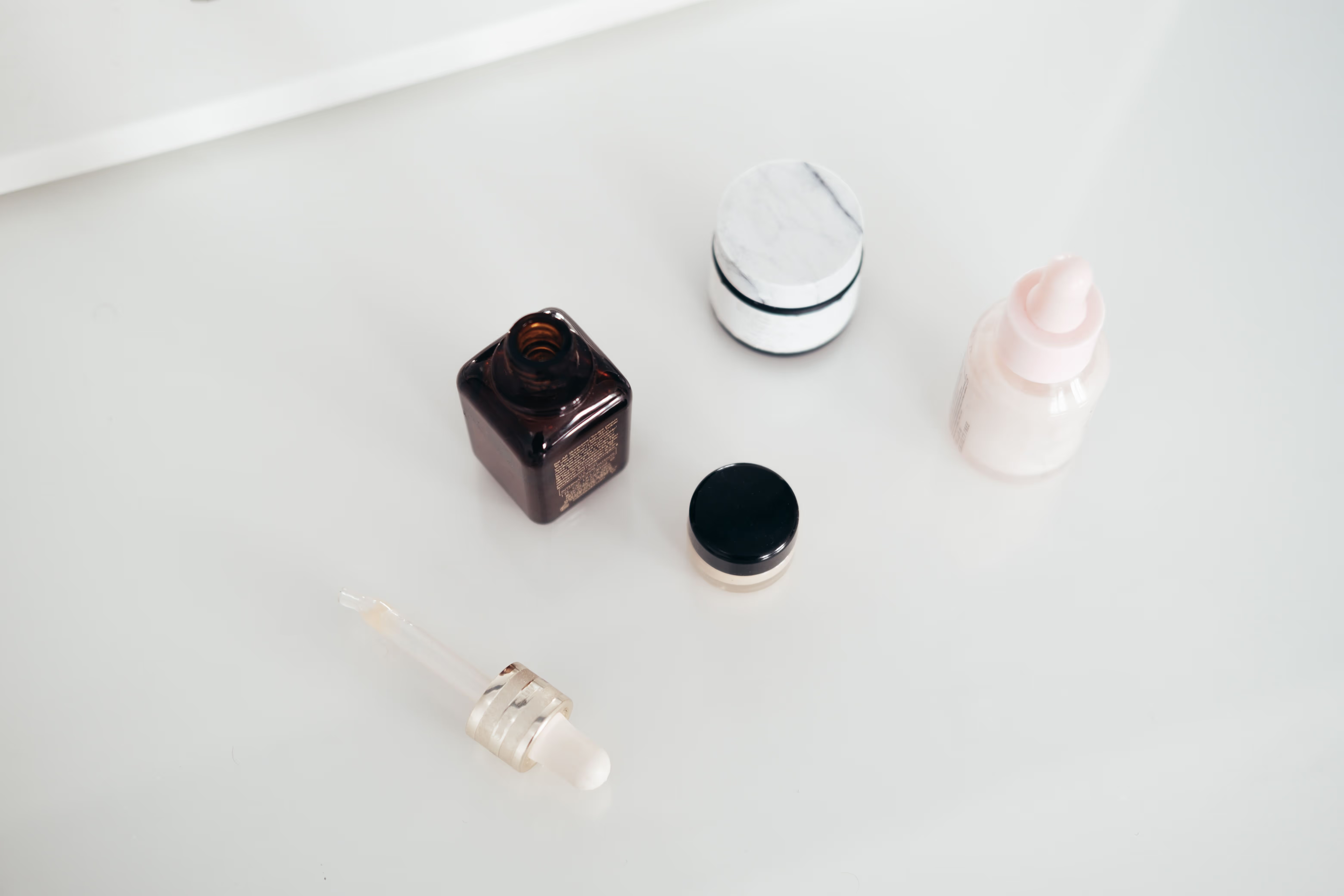
Three of the most-hyped anti-aging ingredients in your feed are really the same molecule caught at three different points of one chemical reaction. The label you pick mostly decides how many conversion steps your skin has to run before anything happens — and how loudly your face protests while it does.
What the evidence supports: Retinol, retinal, and tretinoin are all vitamin A derivatives that end up as the same active compound (retinoic acid), and all three measurably improve fine lines, tone, and texture in controlled trials. What separates them is potency and irritation — and those two move in opposite directions.
What’s overstated or unsupported: The viral claim that retinal is “10 to 20 times stronger than retinol” is marketing shorthand, not a settled clinical number. The conversion-step logic behind it is sound; the precise multiplier is extrapolated, and clean head-to-head trials are thinner than the confidence of the claims.
⚕️ LyfeiQ Score: 8/10 — Choose by what your skin tolerates, not by the biggest number on the box. The retinoid you use three nights a week for a year beats the stronger one you quit in a month.
All three sit on the same assembly line, just at different stations. Your skin can only use one form of vitamin A directly: retinoic acid. Everything else has to be converted into it. The pathway runs retinyl esters to retinol to retinaldehyde (retinal) to retinoic acid, and each step costs a little potency along the way.
Tretinoin is retinoic acid — zero conversion steps, which is why it works directly on the cell and needs a prescription. Retinal sits one step away. Retinol sits two steps away. The fewer the steps, the more potent the molecule tends to be, and the more likely it is to irritate. A review of retinoid biology lays out how these forms bind retinoic acid receptors in the cell nucleus to switch on the genes that drive collagen production and cell turnover (J Dermatolog Treat, 2017).
Tretinoin has the deepest evidence base of the three. It is the benchmark every other retinoid gets measured against. In one double-blind, vehicle-controlled study, 0.1% tretinoin lightened the hyperpigmented lesions of photoaging in 90% of patients versus 33% on vehicle, with skin biopsies confirming a 41% drop in epidermal pigment (J Am Acad Dermatol, 1994). Decades of randomized trials sit behind it for wrinkles, tone, and acne.
Retinol is the gentle, well-studied entry point. A 2024 systematic review of anti-aging cosmeceuticals gave retinol a Grade A recommendation — the highest tier in that analysis — alongside vitamin C (Arch Dermatol Res, 2024). A controlled comparison of 0.3% and 0.5% retinol serums found steady improvements in wrinkles, tone, and elasticity over 12 weeks, with one telling detail: the stronger 0.5% side irritated more often than the 0.3% side (Skin Pharmacol Physiol, 2020). That dose-versus-irritation tradeoff is the whole story of this ingredient class in miniature.
Retinal is the form the internet rediscovered. Because it sits a single step from retinoic acid, it tends to act faster than retinol. A year-long controlled study of 0.05% retinaldehyde measured gains in epidermal thickness and skin elasticity against an emollient control (Dermatology, 1999), and a randomized double-blind trial found that 0.05% and 0.1% retinaldehyde creams improved overall photoaging in about 95% of participants while staying well tolerated (J Cosmet Dermatol, 2018). A widely cited review of cosmeceutical retinoids concluded that retinaldehyde is the most efficient of the over-the-counter options and is fairly well tolerated, while plain retinol and retinyl esters are non-irritating but only modestly effective (Dermatol Ther, 2006).
Start from your tolerance, not from the strongest option you can find. The right retinoid is the one you can use consistently for months without rage-quitting from flaking.
If you’re new to retinoids: Start with retinol. Use a pea-sized amount at night, two or three times a week, on dry skin, followed by moisturizer. Build up frequency over several weeks. The early dryness and flaking — sometimes called the retinization period — usually settles within a month or two.
If you’ve outgrown retinol but don’t want a prescription: Retinal is the logical step up. You’ll typically see results sooner than with retinol, generally with less irritation than prescription tretinoin. One practical catch: retinaldehyde is harder to keep stable, so opaque, air-tight packaging matters more here than with other forms.
If you want the strongest evidence-backed option, or you’re treating acne or significant sun damage: Tretinoin, prescribed and monitored by a clinician, is the gold standard. Expect a tougher adjustment period and plan for it.
Non-negotiables for all three: Daily broad-spectrum sunscreen — retinoids can increase sun sensitivity, and unprotected sun undoes the work. Ease in slowly, don’t stack strong actives such as high-strength acids on the same night at first, and if you’re pregnant or breastfeeding, hold off on topical retinoids until you’ve checked with your doctor.
Dermatology’s position is consistent: topical retinoids are among the best-evidenced anti-aging and acne ingredients available, and prescription tretinoin carries the strongest body of randomized-trial data. Clinicians generally match the form to the person — sensitivity, goals, and history — rather than defaulting to the most potent molecule. Over-the-counter retinol is treated as effective but slower, a reasonable choice for maintenance and for skin that cannot take prescription strength.
Within the gentler-is-better camp, the most discussed option is bakuchiol, a plant compound marketed as a “retinol alternative.” Proponents suggest it delivers retinol-like smoothing with less irritation. Early studies are encouraging but preliminary: the same 2024 systematic review that scored retinol Grade A gave bakuchiol only a Grade C, reflecting smaller trials and thinner evidence. It is a credible adjunct or a starting point for very reactive skin, not yet an equal substitute.
Skincare creators declared retinal the molecule of the moment — board-certified dermatologist Dr. Daniel Sugai framed 2025 as “the year of retinaldehyde” in his content, and Dr. Muneeb Shah (@doctorly, with a following north of 20 million) has built retinaldehyde into his own product line. The recurring viral claim is that retinal is roughly 10 — sometimes 20 — times stronger than retinol. The contrasting voice comes from within the same community: plenty of dermatologists push back that those multipliers are marketing extrapolations, that retinal’s instability can undercut a poorly formulated product, and that tretinoin remains the only one of the three with decades of hard outcome data. The honest consensus underneath the hype: all three work, and the gap between them is smaller than the marketing implies.
The inverse relationship between strength and gentleness is real; the tidy multipliers are not. Dermatologists describe these molecules as sitting on an inverted scale: as potency rises, tolerability falls, and the peer-reviewed literature supports that shape. What the literature does not cleanly provide is a validated “retinal equals 10x retinol” conversion factor. Those numbers come from potency estimates and product marketing, not from large trials testing the three molecules head-to-head at matched endpoints. So treat the ranking as directional, not precise: tretinoin generally strongest and best-documented, retinal a faster-acting middle ground, retinol the gentle and well-supported entry. The molecule that actually changes your skin is the one you keep using.
Three threads are worth watching. Encapsulation and stabilized delivery systems are closing the gap between forms by making fragile molecules like retinaldehyde last longer and irritate less. The field still needs more direct head-to-head randomized trials comparing retinal, retinol, and tretinoin at the same concentrations and endpoints, which would finally replace marketing multipliers with measured ones. And there is growing interest in how retinoids perform across diverse skin tones and pigmentation concerns, an area where the early photoaging research was narrow.
What is the retinoid family’s LyfeiQ?
Credibility Rating: 9/10
👉 Who should try this: Anyone targeting fine lines, uneven tone, rough texture, or acne who can commit to consistent nightly-ish use and daily sun protection. Start gentle and build.
👉 Who should skip this: People who are pregnant or breastfeeding (pending medical advice), anyone mid-flare with eczema or rosacea until calmer, and those unwilling to wear sunscreen daily.
⚕️ LyfeiQ Score: 8/10 — Pick the form your skin can tolerate, introduce it slowly, protect with sunscreen, and give it months. The differences between these three matter far less than whether you actually stick with one.
Related: Do Skincare Peptides Work, or Are They Simply a Marketing Tactic?
Disclaimer: This content includes personal opinions and interpretations based on available sources and should not replace medical advice. This content includes interpretation of available research and should not replace medical advice. Although the data found in this blog and infographic has been produced and processed from sources believed to be reliable, no warranty expressed or implied can be made regarding the accuracy, completeness, legality or reliability of any such information. This disclaimer applies to any uses of the information whether isolated or aggregate uses thereof.