

August 24, 2026
10 min
Maya Q.
July 20, 2026
6 min
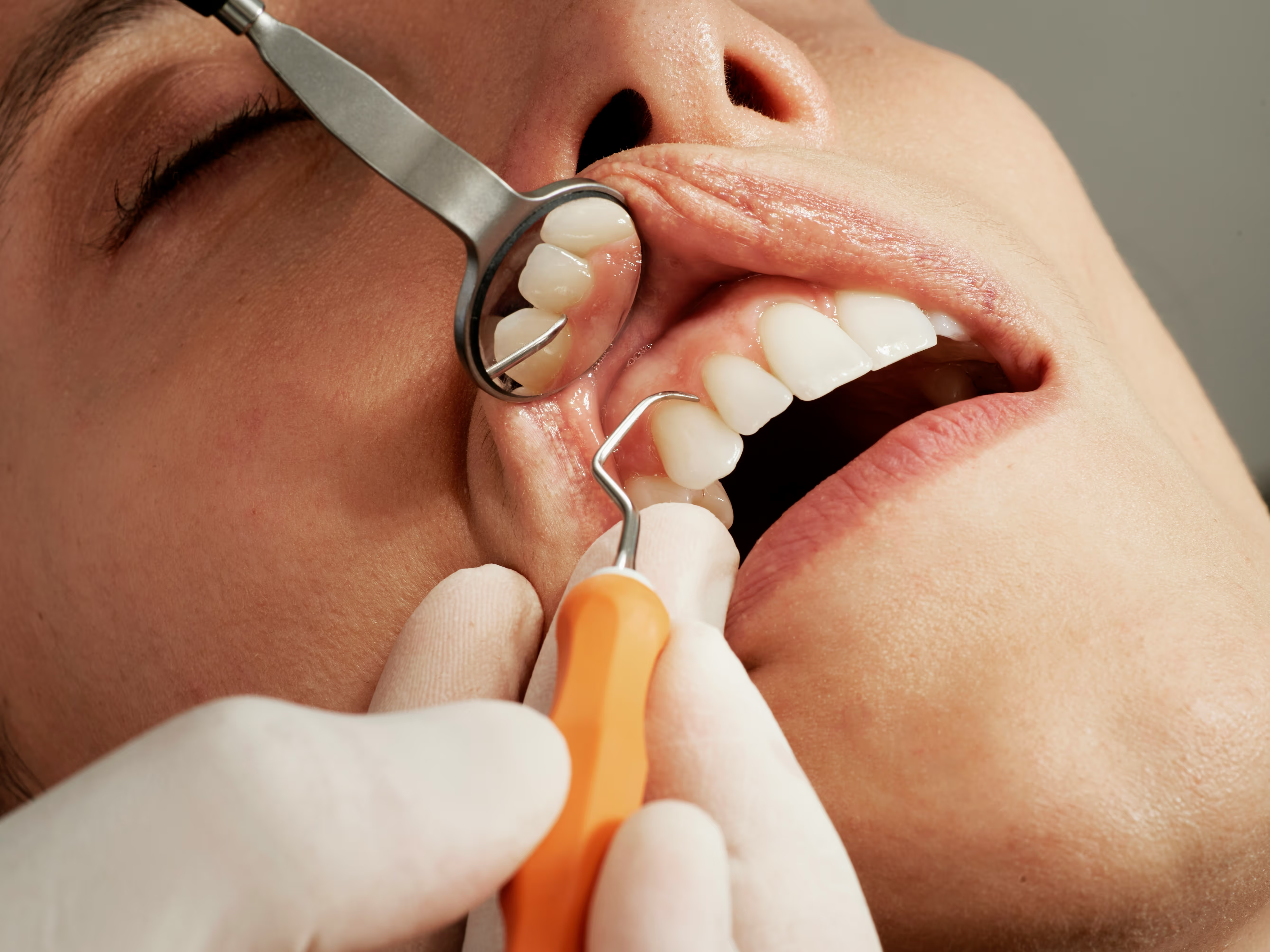
You’re standing in the toothpaste aisle, scrutinizing labels, when a familiar word catches your eye: fluoride. It’s on nearly every tube and mouthwash bottle — yet for a mineral that’s been in your bathroom since childhood, it somehow keeps sparking controversy. Is fluoride a cornerstone of preventive dentistry or an unwanted additive in your water supply? The answer, as always, is more interesting than the headlines suggest.
✅ What the evidence supports: Fluoride has strong, multi-decade clinical evidence for reducing dental caries in both topical applications (toothpaste, professional treatments) and community water fluoridation. A 2015 Cochrane review found water fluoridation reduced cavities in children by up to 35%.
⚠️ What’s overstated: Claims that typical fluoride exposure from toothpaste or fluoridated water causes systemic toxicity are not supported at recommended levels. Dental fluorosis (cosmetic spotting) can occur with excess intake in young children, but this is distinct from serious health harm.
⚕️ LyfeiQ Score: 8/10 — Fluoride is one of the most well-studied preventive health interventions in dentistry. Use it in toothpaste; the water fluoridation debate is more about policy than peril.
Fluoride’s cavity-fighting credentials are among the most replicated findings in dental medicine. Decades of clinical research have established that fluoride strengthens tooth enamel through remineralization, inhibits the bacteria responsible for decay, and reduces the incidence of caries across all age groups.
A 2015 Cochrane systematic review analyzed data from water fluoridation studies and found that children in fluoridated communities had 35% fewer decayed, missing, or filled baby teeth and 26% fewer in permanent teeth. The review also noted that many underlying studies predate modern dietary changes, so the relative benefit today is likely smaller — though still meaningful (Iheozor-Ejiofor et al.).
A 2025 review in the International Dental Journal (Samaranayake et al.) examined the fluoride controversy comprehensively and concluded that evidence for topical fluoride remains robust across systematic reviews and meta-analyses, with community water fluoridation continuing to demonstrate preventive benefit — particularly in populations with limited access to dental care.
On the mechanistic side, fluoride ions (F⁻) penetrate bacterial cells in their hydrogen fluoride (HF) form, dissociate inside, and disrupt the enzymatic processes bacteria use to metabolize sugars — the very process that produces enamel-eroding acids (Marquis, 1995; Ji et al., 2014).
For most adults, the evidence points to a simple, low-effort protocol: fluoride toothpaste twice daily. Here’s what the research supports:
If you’re concerned about your intake — especially for young children — discuss it with your dentist. Risk varies significantly by diet, water source, and existing dental health.
The scientific and public health consensus is clear: fluoride works, and it’s safe at recommended levels. The American Dental Association endorses both fluoride toothpaste and community water fluoridation as safe and effective for preventing tooth decay in children and adults. ADA president Linda J. Edgar, D.D.S., noted in 2024 that even in an era with widespread fluoride toothpaste availability, community water fluoridation still prevents at least 25% of tooth decay across a lifetime.
The Centers for Disease Control named water fluoridation one of the ten great public health achievements of the 20th century. The NIH, WHO, and CDC all support its continued use. Peer-reviewed journals including The Cochrane Database of Systematic Reviews and Healthcare consistently find net benefit across populations.
Alternative and integrative health practitioners don’t uniformly oppose fluoride — most acknowledge its topical benefits — but water fluoridation is where opinions diverge. Practitioners in the integrative space often raise two concerns: (1) involuntary mass medication without individual consent, and (2) uncertainty about long-term systemic effects at low doses.
The International Academy of Oral Medicine and Toxicology (IAOMT) has published position papers arguing that aggregate fluoride exposure from water, toothpaste, and food deserves more caution, particularly for children. Some integrative practitioners point to preliminary research on potential associations with thyroid function and neurological development — though critics note these studies typically involve fluoride concentrations far above U.S. drinking water levels.
The NCCIH does not oppose fluoride but encourages patients to discuss individual risk factors with their providers. Most integrative practitioners recommend fluoride-conscious oral hygiene alongside dietary sugar reduction as complementary strategies, not wholesale elimination.
Social media has amplified fluoride skepticism significantly, particularly in wellness communities on TikTok and Instagram. Common claims include: fluoride is a “neurotoxin,” water fluoridation is mass medication without consent, and fluoride-free toothpaste is equally effective.
These claims range from partially true to misleading. Fluoride is toxic at high doses — as is virtually every mineral, including table salt — but toxicity at recommended exposure levels is not supported by the preponderance of peer-reviewed evidence. The fluoride-free toothpaste claim is more nuanced: hydroxyapatite toothpaste shows promising early results in some studies, but the evidence base is not yet as strong as for fluoride.
On the other side, dental professionals have become increasingly vocal on TikTok and YouTube. Many debunk viral fluoride claims with citations, noting that the populations most harmed by removing fluoride from water would be low-income communities with limited access to dental care — a public health equity argument that rarely surfaces in wellness-influencer content.
The core science on fluoride is not genuinely contested — but the policy debate around water fluoridation is legitimate and separate from the safety debate. Here’s how to read the landscape:
Fluoride toothpaste: Near-universal expert consensus. The evidence is strong, the risk profile at recommended amounts is minimal, and the benefit for cavity prevention is clear.
Community water fluoridation: Supported by mainstream public health bodies globally. The main legitimate critiques are about autonomy and diminishing marginal returns in an era of ubiquitous fluoride toothpaste — not evidence that fluoride at 0.7 mg/L causes harm.
Fluoride-free alternatives: Hydroxyapatite toothpaste is the most evidence-backed alternative, with some RCTs showing comparable remineralization in adults. It’s a reasonable choice for those who prefer to avoid fluoride, particularly for young children — but the evidence is still maturing.
The marketing layer: Brands selling “natural” fluoride-free products have a financial incentive to amplify fluoride fears. Evaluate whether the content you’re consuming is peer-reviewed or connected to a product sale.
The most interesting open questions in fluoride science are about precision, not safety. Researchers are exploring individualized caries risk models — using microbiome data, diet, and genetics — to tailor fluoride recommendations rather than applying population-wide standards. Hydroxyapatite and bioactive glass technologies are being studied as adjuncts or alternatives for specific populations. Silver diamine fluoride, a minimally invasive treatment that arrests decay without drilling, is expanding in clinical use and represents a promising frontier for underserved pediatric populations.
Credibility Rating: 8/10
👉 Who should try this: Anyone with normal dental health who wants evidence-backed cavity prevention. Fluoride toothpaste is appropriate for virtually all adults and children over age 3.
👉 Who should skip this: Those with diagnosed fluoride sensitivity or families in areas where water fluoride levels already exceed recommended limits may want to discuss individual intake with their dentist. Fluoride-free hydroxyapatite toothpaste is a reasonable, if less-studied, alternative.
⚕️ LyfeiQ Score: 8/10 — Fluoride earns high marks for its cavity-fighting power and decades of robust clinical evidence. Use fluoride toothpaste; skip the anxiety about your water supply unless your local levels are unusually high. If you have young children, a quick conversation with your dentist about appropriate exposure is always worthwhile.
Disclaimer: This content includes personal opinions and interpretations based on available sources and should not replace medical advice. This content includes interpretation of available research and should not replace medical advice. Although the data found in this blog and infographic has been produced and processed from sources believed to be reliable, no warranty expressed or implied can be made regarding the accuracy, completeness, legality or reliability of any such information. This disclaimer applies to any uses of the information whether isolated or aggregate uses thereof.