
September 30, 2026
9 min
Kenneth D
October 2, 2026
6 min
“Taking peptides” has become something people say the way they once said “taking vitamins.” But a peptide isn’t a product, a category, or a promise. It’s a chemistry word — and it’s quietly doing a lot of work it was never meant to do.
What’s actually true: Peptides are a legitimate, deeply studied class of medicine — short chains of amino acids, with roughly 80 approved for human use, including insulin and the GLP-1 drugs behind Ozempic and Wegovy. The approved ones are made in FDA-registered plants and tested batch by batch.
What’s misleading or unregulated: The identical word is stamped on vials sold online “for research only,” with no FDA approval, no manufacturing standard, and no guarantee the vial contains what the label claims. The credibility of the regulated end gets borrowed by the unregulated end — and most buyers can’t tell which end they’re holding.
A peptide is just a short chain of amino acids linked together — the same building blocks that make up proteins, only fewer of them. Chemists usually reserve “peptide” for chains up to roughly 50 amino acids and “protein” for anything longer; insulin, at 51, sits right on the border, which is why you’ll see it called both. What matters for a reader is that “peptide” describes the shape of a molecule, not its purpose, its quality, or its legality. Aspirin and cyanide are both “small molecules,” too.
As a drug class, peptides are old, mainstream, and growing. Insulin has been manufactured since the 1920s. Today roughly 80 peptide drugs have been approved for human use, and more than 11 percent of all drugs the FDA approved between 2016 and 2024 were synthetic peptides. They treat diabetes, osteoporosis, some cancers, and — most visibly — obesity, through the GLP-1 receptor agonists semaglutide and tirzepatide.
How a peptide gets made turns out to matter more than most buyers realize. There are two main routes. One is recombinant production: insert the genetic instructions for the peptide into living cells and let them grow it. Branded semaglutide is made this way — Novo Nordisk engineers the backbone in brewer’s yeast (Saccharomyces cerevisiae) through fermentation, then finishes it with controlled chemical steps. The other route is solid-phase peptide synthesis, or SPPS: building the chain one amino acid at a time through pure chemistry. Generic and compounded peptides lean heavily on SPPS, and complex molecules like tirzepatide are practical to make only by synthesis.
The method isn’t just trivia, because synthesis can leave things behind. When a peptide is built chemically, the process can generate closely related impurities — chains with an amino acid inserted, deleted, or flipped — that differ subtly from the intended drug. Some of those impurities can provoke an immune response the original molecule wouldn’t. That’s not hypothetical: the FDA issued dedicated guidance in 2021 for exactly this problem, requiring makers of synthetic generic peptides to identify and control such impurities. For an approved drug, every batch is tested for identity, purity, potency, and sterility before it reaches a pharmacy. For a vial bought off a website, none of that is guaranteed to have happened at all.
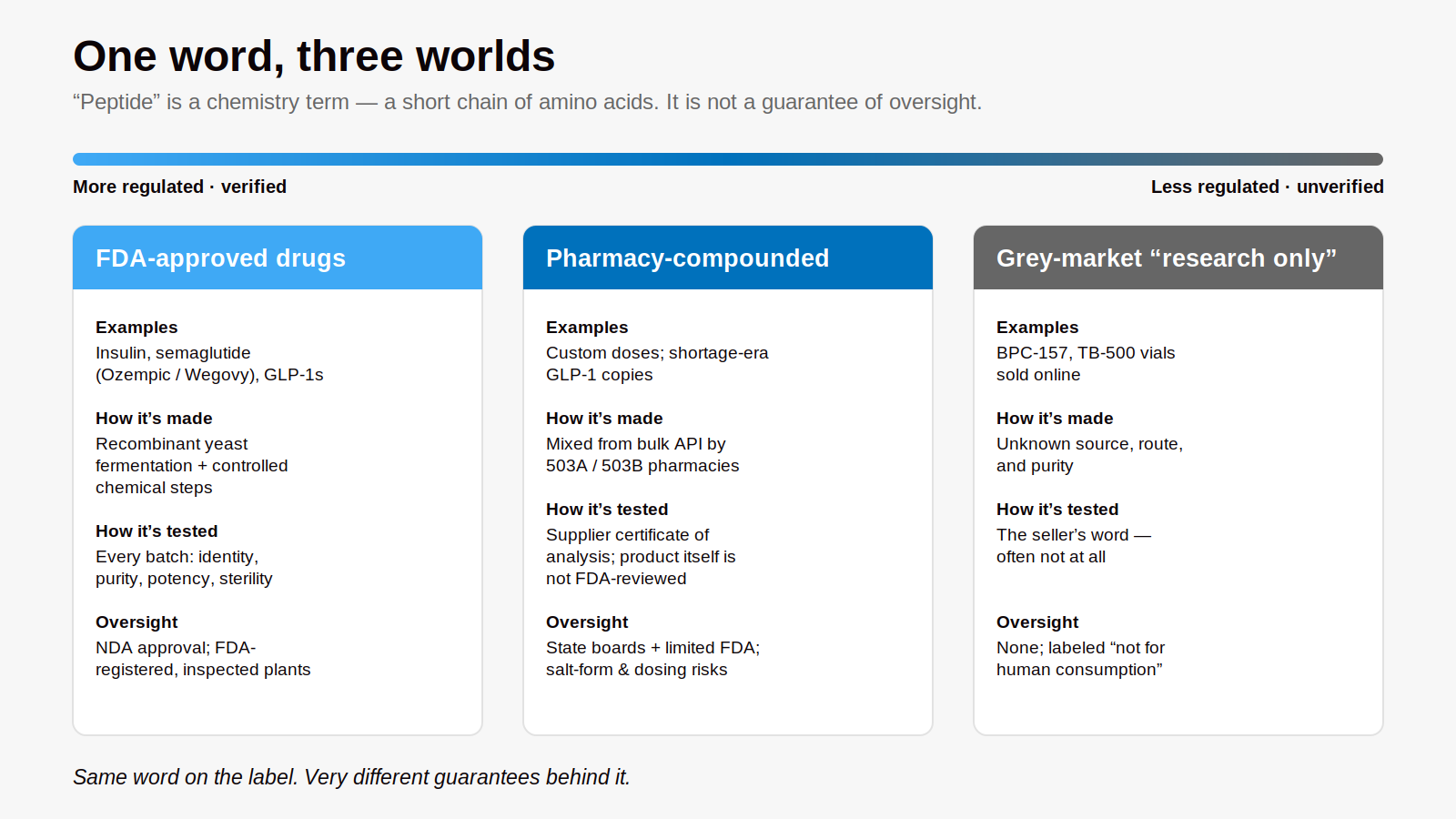
That gap — between a molecule and a guarantee — is where “taking peptides” splits into three very different worlds. The first is FDA-approved prescription drugs: insulin, the GLP-1s, and dozens of others, prescribed, dispensed, and made under federal oversight. The second is pharmacy compounding. Under sections 503A and 503B of federal law, licensed pharmacies can mix a drug to order — a non-standard dose, say, or a formulation for a patient who can’t use the commercial product — using bulk ingredients that carry a certificate of analysis from a registered supplier. The FDA’s own advice to those pharmacies is blunt: know your bulks supplier. The third world is the grey market: vials sold directly to consumers online, often labeled “research only.”
Compounding is legal and often useful, but it isn’t the same as approval — the agency doesn’t review a compounded product for safety, effectiveness, or quality before it’s sold. During the 2022–2024 GLP-1 shortages, compounders and telehealth companies filled the gap with copies of semaglutide and tirzepatide. Some used salt forms — semaglutide sodium, semaglutide acetate — which the FDA says are different active ingredients from the approved drug, with no data showing they behave the same way and no lawful basis for use in compounding. Once the FDA declared the shortage resolved in early 2025, the broad legal window for compounding copies closed. The risks that surfaced during the boom didn’t: as of May 31, 2026, the FDA had logged 990 adverse-event reports tied to compounded semaglutide and more than 730 tied to compounded tirzepatide, including hospitalizations from dosing errors — in some cases, people gave themselves many times the intended amount.
The grey market is where the word does its heaviest lifting. Search for BPC-157, TB-500, or “growth-hormone peptides” and you’ll find vials sold for a fraction of a prescription’s cost, frequently stamped “for research purposes” or “not for human consumption.” The FDA has warned that companies use exactly that labeling to sell unapproved drugs for human use, dosing instructions included — a paper fiction that lets a seller skip the rules a real medicine has to follow. On social media, these peptides are promoted for healing, anti-aging, fat loss, and recovery, often by sellers or influencers with something to gain. And the popular ones aren’t in some minor pending queue: BPC-157, TB-500, KPV, and MOTs-C are not FDA-approved and are not on the agency’s list of substances permitted for compounding. As of mid-2026, an FDA advisory committee is weighing whether they can be compounded at all — the human evidence behind them is thin enough that the question is still open.
So what does this mean if you’re considering peptides? The single most useful question is which world a product comes from. If it’s an FDA-approved drug, a licensed prescriber and a real pharmacy are involved, and the label names them accurately. If a product is sold “for research only” or “not for human consumption,” that is not a discount medicine — it’s a signal that no one has vouched for what’s inside. Deep discounts, no prescription, no named prescriber, a pharmacy that doesn’t seem to exist, packaging that arrives warm or damaged: the FDA lists these as red flags for a reason. Injectables are the highest-stakes category of all, and the safe move for anything you’d put in your body is to route the decision through a licensed clinician or pharmacist rather than a checkout page.
None of this makes “peptide” a dirty word. The approved ones are among the most rigorously tested medicines available. But the label travels freely between the best-regulated and least-regulated corners of the drug world, and it carries none of that context with it. For the grey-market compounds, the long-term effects simply haven’t been studied; for the salt forms, the basic pharmacology is unknown; and for BPC-157 and its cousins, even the regulators haven’t finished deciding what’s permissible. The molecule in the vial might well be a peptide. That, by itself, tells you almost nothing about whether it’s safe, legal, or even what the label says it is.
Related: The Science of the Placebo Effect
Disclaimer: This content includes personal opinions and interpretations based on available sources and should not replace medical advice. This content includes interpretation of available research and should not replace medical advice. Although the data found in this blog and infographic has been produced and processed from sources believed to be reliable, no warranty expressed or implied can be made regarding the accuracy, completeness, legality or reliability of any such information. This disclaimer applies to any uses of the information whether isolated or aggregate uses thereof.