
November 3, 2025
11 min
Maya Q.
January 15, 2026
8 min
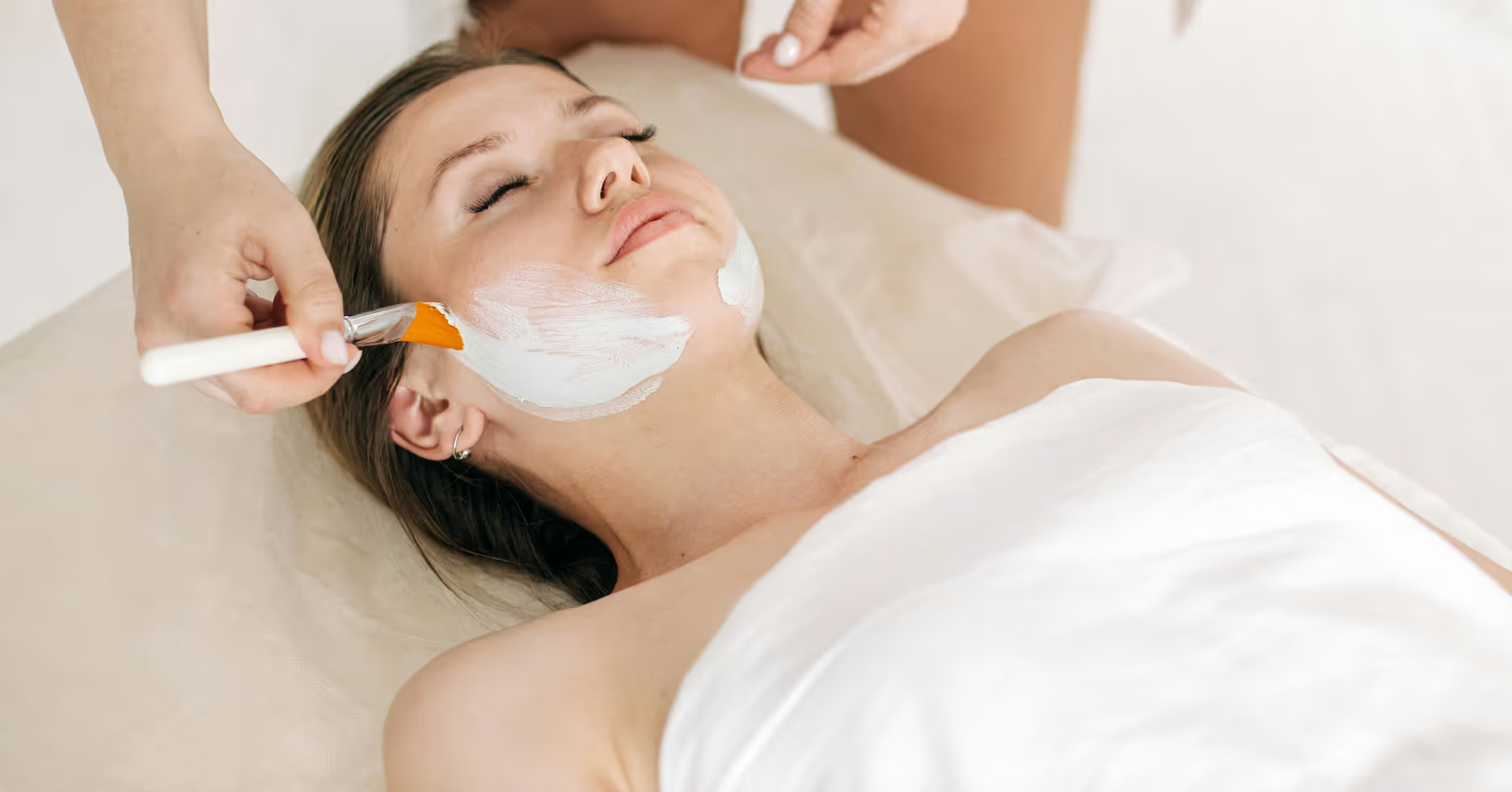
Walk into any beauty parlor these days and you're attacked by rows of creams and serums touting a single celebrity ingredient: peptides. They are touted as a new‑age miracle that tightens the skin, erases years of visible aging, and turns on collagen. Peptides have nearly become the "must‑have" active for health‑minded consumers all over the world, promising anti‑aging power from science without irritation or needles.
But how real is this promise? While research on peptides suggests they can improve certain aspects of skin health, the story is more complicated than marketing implies. Clinical evidence is still limited, absorption through the skin can be a significant barrier, and results are often more subtle than dramatic. This tension between theory, research, and commercial storytelling reveals why peptides are fascinating and controversial ingredients in today’s skincare landscape.
Essentially, peptides are small protein fragments that act as messengers in the body. They can tell cells to do something particular, such as regrowing tissue, creating fresh collagen, or calming inflammation. As aging skin is defined by low collagen and elastin, skincare scientists have put peptides in the spotlight as molecular "coaches" that condition skin to behave more youthfully.
Several peptides are used in cosmetic therapy. Signal peptides are formulated to stimulate fibroblasts to produce more collagen. Carrier peptides help with the delivery of trace minerals such as copper into the skin, which can activate repair enzymes. Enzyme‑inhibiting peptides work to inhibit the breakdown of collagen and elastin, and neurotransmitter‑inhibiting peptides are marketed as topical products that relax lines of expression like Botox.
Conceptually, peptides make sense. They are active biologically, and usually not irritating, and extremely adaptable with respect to formulation. This renders them extremely attractive both to dermatologists searching for retinoid alternatives as well as to customers seeking mild, "advanced science" therapies.
Clinical Evidence
Trials with cosmeceuticals that contain peptides do reveal improvement but in general on a minor scale. Early trials with formulations incorporating palmitoyl pentapeptides have recorded decreased wrinkle depth and improved texture of the skin after treatment over weeks. Copper peptides are studied for their wound-healing and tissue‑repair capabilities, with some to indicate that they can promote skin regeneration.
Much of the research in this field, however, is small, short in duration, or funded by cosmetic product makers. This makes findings less solid. While results are positive, they do not reveal the revolutionary anti-aging findings that consumers are led to expect. The general consensus within dermatology is that peptides can be helpful in improving hydration, elasticity, and wrinkles to some degree, but not nearly as much as retinoids, vitamin C, or treatments performed professionally.
The Barrier Challenge
One of the biggest obstacles for peptides is the skin biology. The stratum corneum is a powerful barrier that allows only small, lipid‑soluble molecules through to the inner layers. The majority of peptides are too big or too unstable to penetrate well. Thus, they generally remain in the epidermis or to function primarily at the surface, adding hydration rather than stimulating collagen synthesis in the dermis deep down.
This is why consumers typically end up with smoother, more filled-out skin in the short term but see change wane when the product is discontinued. These effects happen but are largely surface-dependent. Breaking through this barrier is a frontier of peptide science.
The methodological constraints of peptide research reflect problems in cosmeceutical science in general. Research is small, sometimes in the dozens. They are usually less than 12 weeks' duration, which prevents it from being easy to ascertain long-term effects. Industry sponsorship is common, and tested products often contain a number of actives such as retinol and antioxidants that confuse interpretation.
The lack of uniform testing procedures creates yet another complication. Wrinkle depth is measured in some trials using imaging devices and in others using dermatologists' grading or consumer self-reports. Such variations make it difficult to make studies comparable, to reproduce results, or to make firm conclusions regarding effectiveness.
Despite these issues, the area of peptide research is evolving. Scientists are investigating new delivery systems designed to facilitate skin penetration, including lipid‑based carriers, microemulsions, and microneedle‑assisted delivery. These advancements have the potential to allow peptides to reach the dermis in higher concentrations without being degraded during transport.
Copper peptides are an area of active research because they are already proven for wound healing. They have been found to influence mechanisms relating to inflammation control, repair tissue, and antioxidant activity, which would be a cosmetic benefit if used appropriately.
Asian research communities, particularly South Korea and Japan, are firmly ahead in peptide cosmetic science. These communities are not just using natural peptides but engineered analogs that are improved for higher stability and better bioactivity.
In holistic skincare communities, peptides are described as gentle and organic collagen inducers. They are being touted as a safer option compared to retinoids, typically paired with supplements like oral collagen or bone broth in an attempt to offer a "whole‑body rejuvenation" remedy.
While intriguing, these claims spill beyond the data. There are no robust clinical trials to demonstrate that supplementing with collagen and applying peptide creams simultaneously yields synergistic anti-age effects. Furthermore, certain holistic marketing tales market unsubstantiated concepts, such as peptides' ability to "reset cell age" or give stem-cell-like advantages. Such claims sound enticing, yet they're not science-driven.
On Instagram, TikTok, and YouTube, peptides have even been tagged as "Botox in a bottle." Influencers encourage before-and-after reveals with spectacular makeovers, with sometimes edited or filming under perfect lighting to create a more dramatic effect.
Although peptides do moisturize and improve texture, short-term effects are exaggerated by the camera. Not many influencers explain that the apparent effects are largely temporary or confounded with other products and professional treatments. Sponsorships also mask the difference between genuine consumer experience and marketing narrative.
The influencer cult plays a big role in sustaining great interest in peptide‑based skincare products among customers but has the potential to hasten hype much further than at this point science actually warrants.
Peptides are not misleading, but their impact is frequently overemphasized. The main reasons behind the disconnect are:
The sector is advancing, and a number of these advances might reveal better in terms of where peptides fit within skincare science:
Conventional medical opinion: Providers like Mayo Clinic and Cleveland Clinic state that peptides are able to marginally increase hydration and wrinkles but are inferior to proven treatments like retinoids or professional treatments.
Holistic opinion: Complementary medicine groups extol peptides as gentle, natural cures but typically append unsubstantiated anecdotes and nutritional synergy tales.
Influencer opinion: Social media influencers hype peptides as miracle products or Botox alternatives, overstating what they can offer.
Together, these perspectives suggest a disconnect between the reality of peptides and the expectation of peptides. Peptides are not valueless; they are likely valuable, low-risk components. But they are still falling short of the image of miracle created by marketing and online culture.
A sincere score for peptides today would be 3 out of 5 on credibility and usefulness: effective and safe but subject to considerable limitations and prone to getting overblown.
Peptides score a 6 out of 10 on the LyfeiQ scale for credibility and applicability in skincare, as while they show promise in improving hydration, elasticity, and wrinkles to some degree, current research is limited by small studies, industry funding, and delivery challenges, leading to modest effects that fall short of the dramatic anti-aging claims often hyped by marketing and influencer culture.
Peptides illustrate the way in which cosmetic markets will outstrip scientific certainty. They are fascinating, biologically plausible, and have measurable but limited impact. They create enthusiasm because they promise renovation without irritation or interventional measures. Their biggest limitation, though, still remains: hydration and surface effects are their dominant action until more refined delivery systems exist.
The future holds more knowable and more effective outcomes as newer technologies overcome absorption barriers.