
November 3, 2025
11 min
Nathan J
January 15, 2026
10 min
Imagine standing in the grocery aisle, holding a box of your favorite crackers. You flip it over to check the nutrition facts, but suddenly, you feel like you are reading a chemistry exam. Butylated Hydroxytoluene. Tocopherols. Sodium Benzoate. It sounds terrifying. It sounds like something that belongs in a beaker, not your belly. You might instinctively put the box back on the shelf because we have been trained to fear what we can't pronounce. It is a natural human reflex to avoid the unknown. But here is the twist: many of these "monsters" are actually heroes in disguise. Without them, your pantry would be a breeding ground for mold, bacteria, and deadly toxins. Let’s decode the label and find out why "chemical" isn't a dirty word.
The science of keeping food fresh has evolved drastically since the days when we simply buried meat in salt to keep it edible. Since the mid-2000s, food safety research has exploded with a singular goal: figuring out how to stop food from killing us without hurting us in the process. The golden rule of this research is that "the dose makes the poison." A 2018 review in Nature reiterated that toxicity depends entirely on the amount you consume. Even water can be deadly if you drink too much of it too fast, yet the scariest-sounding preservatives are used in microscopic amounts.
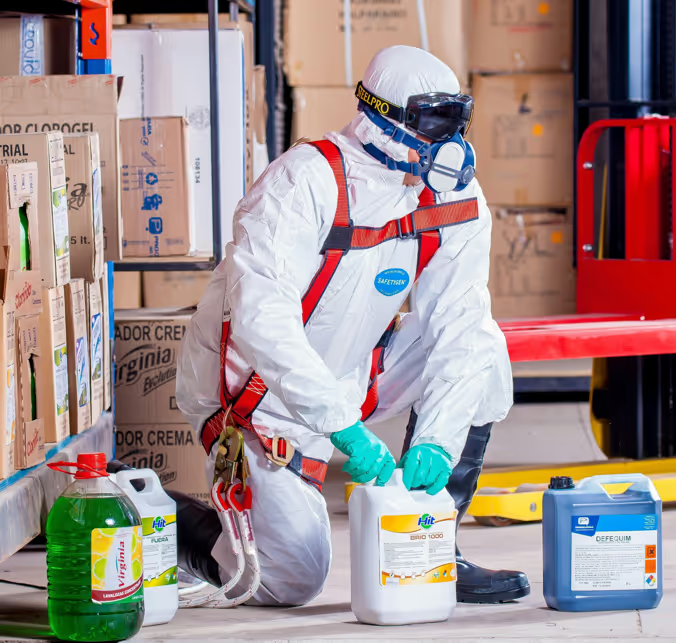
When you start translating these scary names, they often turn out to be harmless, familiar compounds. Take ascorbic acid, for instance. It sounds like something that would burn a hole in your table, but it is simply the scientific name for Vitamin C, used to keep fruit from turning brown. Similarly, tocopherols are just fancy terminology for Vitamin E, which stops oils from going rancid. Even the more chemical-sounding potassium sorbate is a salt that prevents yeast and mold from growing on your food. According to the European Food Safety Authority (EFSA), this compound breaks down into water and carbon dioxide in your body, leaving no trace behind. Regulatory bodies like the FDA set an "Acceptable Daily Intake" for these ingredients by finding the amount that causes zero harm in animals and then dividing that number by 100 to be extra safe. You would essentially have to eat thousands of servings of a preserved food every single day to reach a dangerous level.
Of course, science is a process of constant learning, and we have to look critically at how these safety tests are actually done. Historically, most safety data comes from giving rats massive doses of a chemical to see what happens. For example, older studies showed that BHA—a common preservative—caused cancer in the forestomach of rats. However, a 2020 review highlighted a major flaw in applying this to us: humans don't have a forestomach. Our biology handles these compounds differently than rodents do, which means some old fears were likely overstated.
However, there is a valid criticism known as the "cocktail effect" that researchers are still working to understand. Current scientific methods are excellent at testing chemicals one by one to ensure they are safe individually. They are less effective at predicting exactly what happens when you mix five different additives and eat them over the course of 40 years. While current data suggests the risk is minimal, this remains a blind spot that scientists are actively working to illuminate to ensure long-term safety.
Mainstream Medical Perspective
When you look at the stance of major health organizations like the Centers for Disease Control (CDC) or the Mayo Clinic, the priority is immediate physical safety. From this viewpoint, preservatives are a massive public health victory. They prevent spoilage and allow fresh food to be transported to "food deserts" where fresh produce is scarce. A 2022 summary from the Cleveland Clinic notes that while we should limit ultra-processed foods, the preservatives themselves are not the primary villain. The medical consensus is that the risk of foodborne illness—like botulism or salmonella—is far higher and more deadly than the theoretical risk of additives. In this view, the chemicals are the bodyguards protecting you from acute poisoning.
Alternative / Holistic Perspective
On the other side of the spectrum, functional medicine practitioners and integrative health experts often take a "precautionary principle" approach. They argue that just because a chemical doesn't kill you immediately doesn't mean it helps you thrive. Proponents like those at the Andrew Weil Center for Integrative Medicine suggest that while additives might be "safe" by FDA standards, they are markers of low-quality food. The argument here is that relying on preserved foods displaces nutrient-dense whole foods from your diet. Some holistic nutritionists also express concern about gut health, citing preliminary studies where emulsifiers appeared to alter gut bacteria in mice, potentially leading to inflammation.
Influencer / Public Perspective
Social media has turned the ingredient label into a battlefield of emotions. Fear-mongering creators on platforms like TikTok often use the "Yoga Mat Chemical" argument to scare viewers. They point out that a chemical used in food, like azodicarbonamide, is also used in industrial products. It is a terrifying comparison, but it lacks context; salt is used to melt ice on driveways, but that doesn't make it poison on your fries. However, a wave of science communicators and food scientists are pushing back. They use their platforms to explain the chemistry, demonstrating that "natural" chemicals like cyanide in apple seeds can be deadly, while "synthetic" preservatives are often harmless. Unfortunately, the algorithm tends to favor the fear, meaning a video screaming "This ingredient is killing you!" often drowns out the calm explanation of bacterial inhibition.
When we pull these threads together, a clearer, less scary picture emerges. The mainstream view is correct about acute safety: preservatives prevent real, deadly diseases and make our modern food system possible. The holistic view, however, makes a valid point about diet quality. If you are eating enough preservatives to worry about toxicity, your biggest problem likely isn't the chemical itself, but the fact that you aren't eating enough fresh vegetables. The influencer wars highlight a communication gap; science has done a poor job of explaining why these ingredients are there, leaving room for fear to take root. We need to stop equating "hard to pronounce" with "harmful." Generally, the ingredient protecting your bread from turning into a fuzzy green brick is doing you a favor.
The future of freshness looks high-tech and much cleaner. We are moving toward "biopreservation," where scientists identify "good" bacteria that can fight off the "bad" bacteria, much like how yogurt cultures work, potentially replacing chemical nitrites in meat. There is also a shift toward intelligent packaging. Instead of putting preservatives in the food, we are developing wrappers and films that release antimicrobial agents only when the temperature rises or spoilage begins. Finally, the industry is heavily investing in plant-based extracts. Ingredients like rosemary and green tea extract are proving to be powerful antioxidants, allowing companies to use "clean label" options that work effectively without scaring consumers with complex chemical names.
It is easy to let a long word on a label ruin your appetite, but it helps to remember that everything is a chemical. A banana is a complex matrix of isoamyl acetate, ethene gas, and acids, yet we view it as simple nature. The preservatives in our food supply are among the most tested substances on the planet, acting as invisible bodyguards against rot and disease. While it is always smart to eat more fresh, whole foods, you don't need to fear the occasional difficult-to-pronounce ingredient. It is likely just there to make sure your dinner is safe to eat.
Credibility Rating: 9/10
The preservatives themselves are safe, effective, and necessary. However, because they are often found in nutrient-poor ultra-processed foods, use them as a signal to balance your plate with fresh options.
Disclaimer: Always consult a healthcare professional. This content includes personal opinions and interpretations based on available sources and should not replace professional medical advice. This content includes personal opinions and interpretations based on available sources and should not replace medical advice. This content includes interpretation of available research and should not replace medical advice. Although the data found in this blog and infographic has been produced and processed from sources believed to be reliable, no warranty expressed or implied can be made regarding the accuracy, completeness, legality or reliability of any such information. This disclaimer applies to any uses of the information whether isolated or aggregate uses thereof.