
August 24, 2026
10 min
Maya Q.
July 20, 2026
8 min
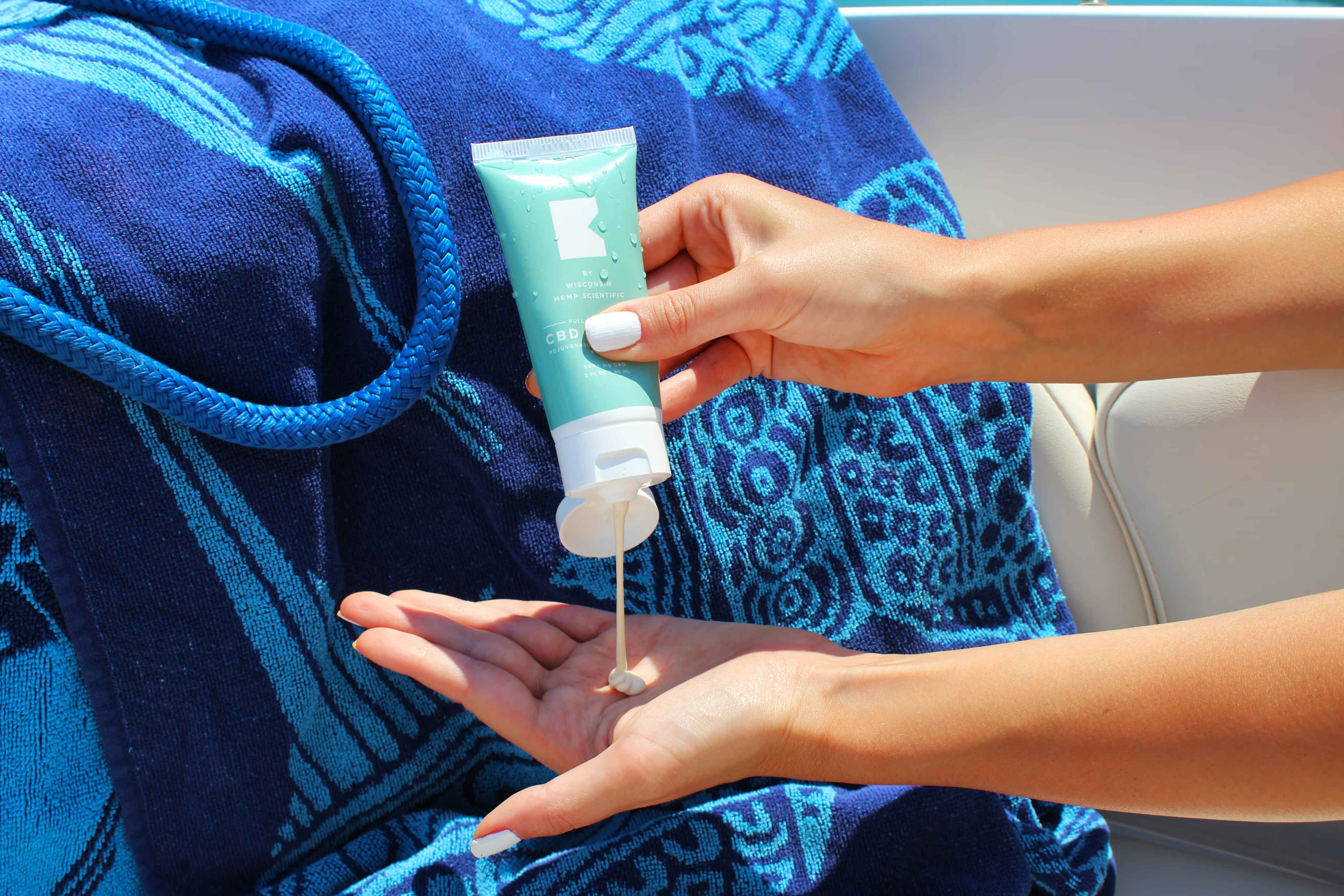
UV radiation doesn't clock out when it's cloudy. Research shows that up to 90% of visible skin aging is caused by sun exposure — and those rays penetrate windows, clouds, and even car windshields year-round. If you're skipping sunscreen on overcast days or quick errands, you're quietly accumulating damage that won't show up for years.
✅ What the evidence supports: Daily broad-spectrum sunscreen (SPF 30+) meaningfully reduces the risk of skin cancer and visible aging. The clinical evidence for this is among the strongest in all of preventive dermatology.
⚠️ What's overstated: Dietary antioxidants (lycopene, green tea polyphenols) offer minor UV protection at best — they do not substitute for topical sunscreen. High-SPF products (SPF 100+) offer only marginally more protection than SPF 50.
⚕️ LyfeiQ Score: 9/10 — Daily sunscreen is one of the highest-evidence preventive health habits you can build. Use it every morning, rain or shine.
The dermatological case for daily sunscreen isn't built on marketing — it's built on decades of clinical evidence tracking real health outcomes. A landmark Australian study published in Annals of Internal Medicine (Hughes et al., 2013) followed more than 1,600 adults over four years and found that daily sunscreen users showed 24% less skin aging than those who used it only occasionally. That's not a cosmetic footnote — it's measurable structural protection.
Multiple large-scale studies have also demonstrated that consistent sunscreen use reduces melanoma risk. The American Cancer Society and the Skin Cancer Foundation both cite UV radiation as the primary modifiable risk factor for all forms of skin cancer, including melanoma, basal cell carcinoma, and squamous cell carcinoma.
The Cleveland Clinic notes that UV radiation doesn't just cause visible sunburn — it directly damages the DNA of skin cells, and that damage accumulates over a lifetime. The Mayo Clinic draws the important distinction between UVA and UVB rays: UVB rays are shorter-wavelength and primarily cause sunburn and are central to skin cancer formation; UVA rays penetrate more deeply, causing long-term structural aging and DNA damage. Both damage skin DNA. Both increase cancer risk. This is why “broad-spectrum” labeling matters — it means the product protects against both.
Published data in peer-reviewed dermatological journals consistently find that SPF 30 blocks approximately 97% of UVB rays, while SPF 50 blocks roughly 98%. The marginal difference matters most for people at elevated risk. The American Academy of Dermatology has also flagged an important equity issue: skin cancers in people with darker skin tones are disproportionately diagnosed at later, more dangerous stages — partly because the myth that darker skin doesn't need sun protection persists, leading to delayed screening and lower usage rates.
One commonly raised concern is whether daily sunscreen use suppresses Vitamin D synthesis. The research here is reassuring: real-world studies show that regular sunscreen users don't develop Vitamin D deficiency at higher rates than non-users, likely because most people don't apply sunscreen with complete coverage, and because Vitamin D is also obtained from diet. If Vitamin D levels are a concern, supplementation is the appropriate solution — not reduced sun protection.
The best sunscreen is the one you'll use consistently — so find a formula that works for your skin and make it a non-negotiable morning step. Here's the practical framework:
Imperfect daily use beats perfect occasional use. Consistent application — even without perfect technique — dramatically outperforms sporadic use with flawless form.
Dermatologists and oncologists are in rare, unified agreement: daily broad-spectrum SPF 30+ is non-negotiable, regardless of weather, skin tone, or season. The Skin Cancer Foundation recommends applying sunscreen 30 minutes before going outside and reapplying every two hours during outdoor activity. The American Academy of Dermatology echoes this guidance and frames sunscreen as preventive medicine — not a cosmetic step.
The Mayo Clinic and Cleveland Clinic both emphasize that skin cancer is the most common cancer in the United States, and that the majority of cases are preventable through sun-protective habits. The medical community treats daily sunscreen as one of the few preventive interventions with clean, large-scale evidence behind it — on par with not smoking and maintaining a healthy weight.
Natural health advocates generally support sun protection but often express concern about the safety of chemical sunscreen ingredients — and some promote dietary antioxidants as a complementary layer of defense. The National Center for Complementary and Integrative Health (NCCIH) acknowledges that certain phytonutrients — including lycopene from tomatoes and polyphenols from green tea — show mild UV-protective properties in some studies. A 2023 systematic review in Critical Reviews in Food Science and Nutrition (Zhang et al.) found that lycopene supplementation was associated with modest reductions in UV-induced skin deterioration markers. Proponents in this space view nutrition as a foundation for skin resilience.
The integrative health community frequently recommends mineral-based sunscreens (zinc oxide, titanium dioxide) over chemical formulations, citing concern about systemic absorption of compounds like oxybenzone. Harvard Health notes that while oxybenzone is detectable in the bloodstream after application, there is currently no evidence that this poses harm at real-world concentrations.
Some voices in alternative wellness also push back against what they describe as “sun phobia” — arguing that moderate, unprotected sun exposure supports Vitamin D synthesis, circadian rhythm regulation, and mood. This is a legitimate point in the context of excessive sun avoidance; it becomes problematic when used to rationalize skipping sunscreen entirely.
Skincare and beauty influencers have arguably done more to normalize daily sunscreen use among younger adults than decades of clinical messaging. On Instagram and TikTok, board-certified dermatologists like Dr. Shereene Idriss and Dr. Joyce Park have amassed large followings by consistently promoting SPF as a non-negotiable step in any routine. Before-and-after comparisons of sun-damaged versus protected skin have become a reliable content format, making the stakes of UV exposure viscerally clear in a way that pamphlets never could.
Influencer content has also addressed real-world usability barriers — testing formulations that don't leave a white cast on darker skin tones, that layer cleanly under makeup, or that feel lightweight enough to actually wear every day. This practical focus has been genuinely useful.
The counterpoint: some influencer content overstates the protection gap between SPF 50 and SPF 100+, creating unnecessary confusion. There's also a persistent fringe trend of recommending antioxidant serums as a replacement for sunscreen — which they are not, and which dermatologists consistently correct. Additionally, the commercial incentives of sponsored content mean followers should independently verify any ingredient claims.
All three perspectives agree on the foundational premise: UV radiation damages skin and increases cancer risk. The disagreement is about emphasis, risk tolerance, and the role of natural approaches.
The mainstream medical position holds the strongest scientific ground. The data from randomized controlled trials, systematic reviews, and longitudinal epidemiological studies is consistent across decades and research teams. The safety profile of sunscreen active ingredients — even the chemical ones — has been extensively studied, and serious adverse effects are extremely rare. The detection of oxybenzone in blood draws attention but does not constitute evidence of harm.
The alternative wellness concerns about ingredient safety are not baseless, but they are often disproportionately weighted. We don't have 50-year longitudinal data on every sunscreen ingredient — that's a fair observation. What we do have is overwhelming evidence that UV-induced skin cancer kills, and that sunscreen reliably reduces that risk. Mineral formulations offer a reasonable middle ground for anyone who wants to reduce chemical exposure without sacrificing protection.
The influencer influence is real and, on balance, probably net positive for public health. SPF has become culturally legible in a way it wasn't a decade ago. The practical barrier-reduction work — finding formulas that work on diverse skin tones, that layer well, that feel good — has meaningfully improved compliance. The areas to watch critically are product comparison claims and anything that suggests a skincare product can replace a sunscreen.
Research is actively exploring next-generation photoprotective compounds derived from marine organisms and plant pigments that may offer broader UV coverage with cleaner ingredient profiles. There is also growing interest in studying sunscreen efficacy across diverse populations — specifically how different skin phototypes and melanin levels affect both UV risk and optimal SPF selection. Separately, researchers are investigating the photoprotective potential of oral antioxidant supplementation as a true adjunct (not replacement) to topical sunscreen, with some early clinical trials showing measurable UV resilience benefits from high-dose nicotinamide (Vitamin B3).
Daily sunscreen earns one of the highest scores we give any health habit — because few interventions have this level of evidence behind them.
Credibility Rating: 9/10
👉 Who should try this: Everyone — regardless of skin tone, season, or how much time you spend outdoors. Daily sunscreen is one of the highest-evidence preventive health habits available.
👉 Who should skip this: There are no populations for whom daily sun protection is contraindicated. Those with sensitive skin or concerns about chemical ingredients should opt for mineral (zinc oxide or titanium dioxide) formulations, which have an excellent safety profile.
⚕️ LyfeiQ Score: 9/10 — Daily broad-spectrum sunscreen is the single most evidence-backed skin health habit you can build. Apply SPF 30+ every morning before you leave the house — and yes, that includes cloudy days in January.
Related: Can Red Light Therapy Really Heal Your Body—Or Is It Just Another Wellness Fad?
1. Hughes, Maria Celia B., et al. “Sunscreen and Prevention of Skin Aging.” Annals of Internal Medicine, vol. 158, no. 11, 4 June 2013, p. 781. https://doi.org/10.7326/0003-4819-158-11-201306040-00002
2. Chien, Anna Lien-Lun. “Sunscreen and Your Morning Routine.” Johns Hopkins Medicine. https://www.hopkinsmedicine.org/health/wellness-and-prevention/sunscreen-and-your-morning-routine
3. Cleveland Clinic. “Ultraviolet (UV) Radiation: What It Is & Its Effect on Your Skin.” Cleveland Clinic, 16 Nov. 2022. https://my.clevelandclinic.org/health/diseases/10985-ultraviolet-radiation
4. Torborg, Liza. “Mayo Clinic Q and A: Sunscreen Best Practices.” Mayo Clinic News Network, 21 June 2016. https://newsnetwork.mayoclinic.org/discussion/mayo-clinic-q-and-a-apply-sunscreen-generously-and-frequently-for-full-protection/
5. Skin Cancer Foundation. “Sun Protection and Vitamin D.” The Skin Cancer Foundation, 14 May 2018. https://www.skincancer.org/blog/sun-protection-and-vitamin-d/
6. Stern, R. S., et al. “Risk Reduction for Nonmelanoma Skin Cancer with Childhood Sunscreen Use.” Archives of Dermatology, vol. 122, no. 5, 1 May 1986, pp. 537–545. https://pubmed.ncbi.nlm.nih.gov/3707169/
7. “What People of Color Need to Know about Sun Protection and Skin Cancer.” American Cancer Society, 16 Aug. 2024. https://www.cancer.org/cancer/latest-news/what-people-of-color-need-to-know-about-sun-protection-and-skin-cancer.html
8. Zhang, Xiaofeng, et al. “The Effect of Tomato and Lycopene on Clinical Characteristics and Molecular Markers of UV-Induced Skin Deterioration.” Critical Reviews in Food Science and Nutrition, 6 Jan. 2023. https://doi.org/10.1080/10408398.2022.2164557
9. Environmental Working Group. “EWG's 2018 Guide to Safer Sunscreens.” https://www.ewg.org/sunscreen/report/whats-wrong-with-high-spf/
10. EWG. “The Trouble with Ingredients in Sunscreens.” https://www.ewg.org/sunscreen/report/the-trouble-with-sunscreen-chemicals/
11. CeraVe. “How to Choose the Right Sunscreen for Your Skin.” https://www.cerave.com/skin-smarts/skin-concerns/sun-protection/what-spf-should-i-use
Disclaimer: This content includes personal opinions and interpretations based on available sources and should not replace medical advice. This content includes interpretation of available research and should not replace medical advice. Although the data found in this blog and infographic has been produced and processed from sources believed to be reliable, no warranty expressed or implied can be made regarding the accuracy, completeness, legality or reliability of any such information. This disclaimer applies to any uses of the information whether isolated or aggregate uses thereof.