

December 1, 2025
11 min
Kenneth D
July 24, 2026
6 min
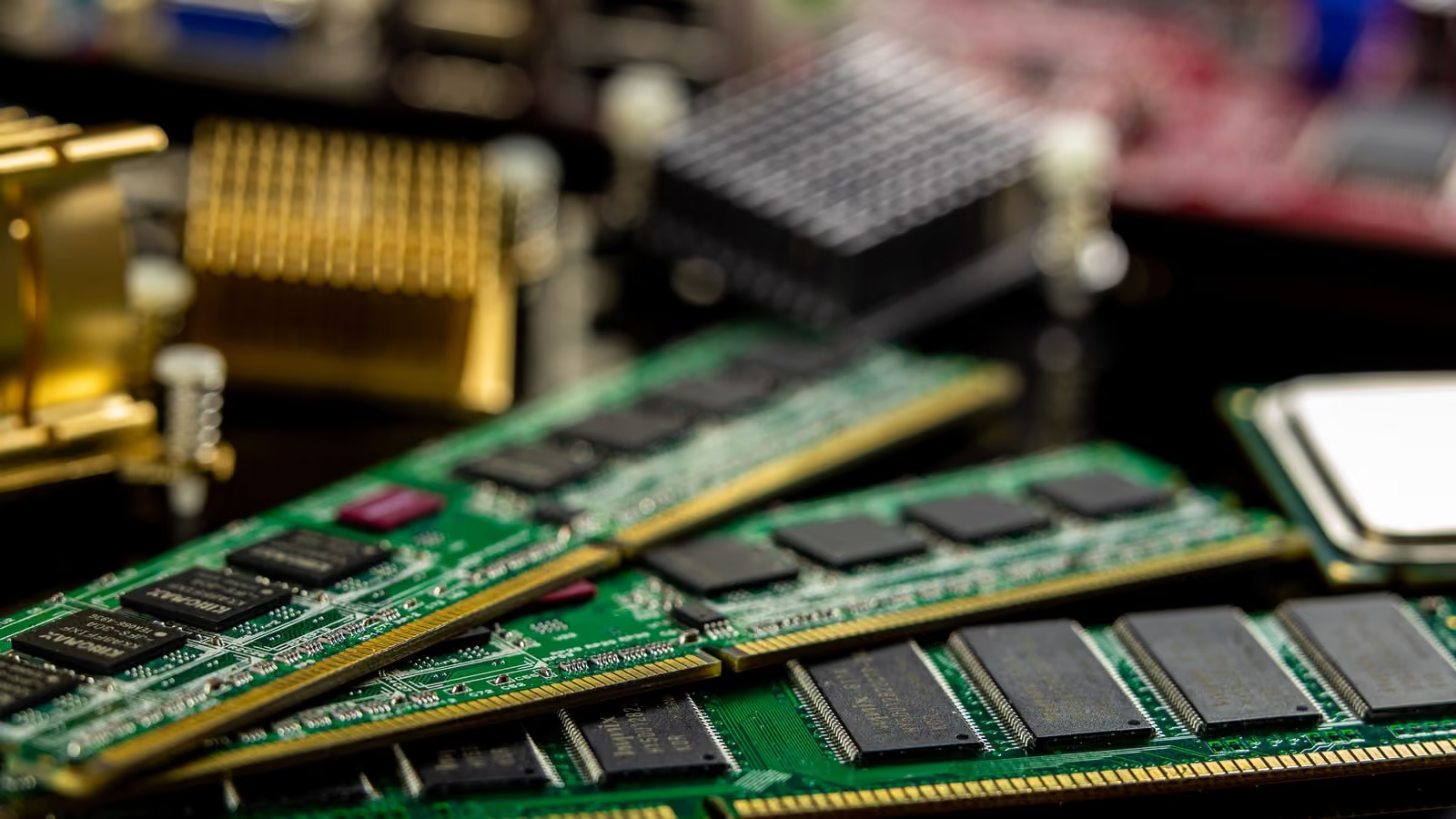
You have probably noticed that building or buying a PC costs far more than it did two years ago. The instinct is to blame the usual suspects — crypto miners, scalpers, plain inflation. This time the real culprit sits somewhere you would never think to look: the data center.
What’s actually true: The 2026 surge in the price of RAM, graphics cards, and processors traces back to one cause — the AI build-out is consuming the world’s memory-chip manufacturing capacity, and almost everything built from those chips got more expensive as a result.
What’s misleading: It looks like ordinary inflation or price-gouging, and PC makers rarely explain the cause. The increases are real and largely structural — not a temporary blip that patience will fix.
For most of the last twenty years, PC hardware got faster and cheaper in lockstep; in 2026 that pattern broke. A memory kit that cost under $90 in mid-2025 was selling for several hundred dollars a year later. A flagship graphics card that launched at $1,999 has been trading well past $3,000. The separate stories mostly rope back to one force — and it is not the one most shoppers assume.
Start with memory, because it explains most of the rest. Just three companies — Samsung, SK Hynix, and Micron — make the overwhelming majority of the world’s DRAM, the working memory in every PC and phone. Those same factories can instead produce high-bandwidth memory, or HBM, the specialized stacked chips that feed AI accelerators in data centers. HBM is far more profitable and far more wafer-hungry: industry estimates put its cost at roughly three to four times the manufacturing capacity per gigabyte of standard memory. So the makers pivoted their lines toward AI. The research firm IDC has described this not as a normal boom-and-bust shortage but as a lasting, strategic reallocation of global silicon capacity, where every wafer sent to an AI chip is one taken from consumer memory.
The price effect was violent. TrendForce data reported across the industry put conventional DRAM contract-price increases near 90 percent in a single quarter early in 2026. On store shelves, Tom’s Hardware tracked a 32GB DDR5 kit climbing from under $90 toward $500, while older DDR4 kits roughly doubled — a jump enthusiasts started calling “RAMageddon.” The structural signals are hard to miss. Micron retired its consumer-facing Crucial memory brand to concentrate on data-center products, and PC makers from Dell to Lenovo warned of double-digit price increases on finished machines, with memory reportedly swelling from roughly a sixth of a PC’s bill of materials to about a third.
Graphics cards got hit through the same door. Every modern GPU carries several gigabytes of fast video memory soldered to the board — the same class of chip, from the same three suppliers now prioritizing AI. As memory prices spiked, video RAM reportedly grew to more than 80 percent of the cost of building a high-end card. Nvidia’s flagship RTX 5090, which launched near $1,999, was soon trading well above $3,000, with some listings far higher. Rather than absorb the cost, Nvidia cut production of its higher-memory cards, steered supply toward cheaper models, and delayed the refresh that would have added more VRAM — because the denser memory that refresh needed was exactly what the shortage made scarce. By several accounts, 2026 became the first year in about three decades without a new consumer Nvidia gaming architecture. AMD’s cards held a little closer to their launch prices, but drew from the same shrinking pool.
Processors moved later and more gently, but they moved. Intel and AMD notified customers of increases through the spring — roughly 5 to 10 percent on consumer chips and as much as 20 percent on server parts. Two forces drove it. The same AI demand is soaking up advanced manufacturing and chip-packaging capacity, and Intel has said it is prioritizing data-center processors over consumer ones. More surprising, AI made CPUs matter in the data center again: as workloads shift from training toward ‘agentic’ inference, the number of processors paired with each batch of AI chips rises, pulling server-chip demand up and diverting supply from desktops. The one bit of relief is that whole-system demand is price-sensitive — push CPU prices too far and people simply stop buying PCs, which caps how high they can climb.
Layered on top of the shortage is trade policy, which raised the baseline on its own. Effective January 2026, the United States imposed a 25 percent tariff on a subset of imported semiconductors and related goods on national-security grounds, with a steeper second phase signaled; separately, tariffs on Chinese chips climbed sharply across 2025. Because the United States makes only about an eighth of the world’s chips, buyers cannot simply switch to domestic supply to dodge the cost. The Information Technology and Innovation Foundation, a think tank broadly skeptical of blanket chip tariffs, estimated the measure would leave the average American about $170 worse off in the first year — a rough gauge of how widely these input costs spread. Reasonable people disagree over whether the trade-off is worth it to rebuild domestic manufacturing; what is not disputed is that, in the near term, it adds cost to hardware that was already scarce.
For shoppers, none of this is visible at the register. The number on the box just went up, and PC makers have been in no hurry to explain why. The temptation is to assume the old villains are back — another crypto mania, another wave of scalping bots. Neither is driving this one. The buyer outbidding you for memory is the largest technology companies on earth, purchasing chips by the data center.
So where does it end? Relief depends on new chip factories coming online, and that is a 2027-to-2028 story at the earliest — and only if AI demand stops climbing. Even then, some analysts think memory may never fully return to its old prices, because the AI era has reset the floor. The opposite is also possible: memory has always been a boom-and-bust business, so if AI spending cools just as new supply arrives, prices could swing back down hard. Which way it breaks is the genuine open question. For anyone shopping in the meantime, the usual advice has flipped. In a normal year, waiting rewards patience with lower prices. Through 2026, waiting has mostly meant paying more.
Disclaimer: This content includes personal opinions and interpretations based on available sources and should not be taken as financial or purchasing advice. Although the data found in this blog has been produced and processed from sources believed to be reliable, no warranty expressed or implied can be made regarding the accuracy, completeness, legality or reliability of any such information. This disclaimer applies to any uses of the information whether isolated or aggregate uses thereof.